


| |
|||||
|
|
|
|
|
|
|
|
|
 |
 |
 |
|
||||||||
 |
||||||||||||
 |
|
|||||||||||
|
||||||||||||
 |
|
|||||||||||
|
||||||||||||
 |
|
|||||||||||
|
||||||||||||
 |
|
|||||||||||
|
||||||||||||
|
|
 |
 |
|
|||
 |
||||||
|
|
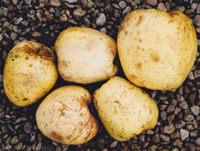 |
CATS AND DOGS This interesting and very tasty apple was introduced to us by Andrew Nicolson of Bradford on Avon, Wiltshire. He found the sorry-for-itself scrubby tree 5 metres from the railway line at Bradford and Avoncliff and next to the fence of a country lane. He warned us of its impending demise at the hands of trackside clearance workers and sent us apples in November 2017 and scionwood the following year, just before and just after the tree had been destroyed, collecting scraps. The name of ‘Cats and Dogs’, given by Andrew, comes from the thorough drenching he got on a fiercely wet day, while collecting scions. The tree might have been planted by a railway worker, it being common for track workers to be given small allotments along the line, but it might also have arisen from a discarded core. If it once had a single trunk, it had been damaged and lost and when found it had three substantial trunks, one over a metre in girth. There was no sign of a graft line. The line opened in 1857 but there are no reasons to believe the tree predated the opening. The apple itself can be very long, tubular, slightly conical and with a distinct snout. The eye is in a deep knobbed/ribbed basin and is usually open. The stalk is short or very short, not that thick, and in a darkly russeted cavity. The matt, waxy, pale yellow skin is liberally sprinkled with prominent russet dots. The new trees have not yet fruited here, so our experience comes from apples sent in November, when they might have been a shade over-ripe, but they were juicy enough, light in texture, pale fleshed, sweet, not sharp, and with a good enough flavour to eat raw, with pleasure. When cooked, the flesh breaks down very quickly indeed to a purée with the flavour much enhanced – sweet, rich and lemony. A very good apple, saved from extinction by Andrew. |
||
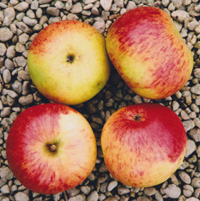 |
CAUDAL MARKET An Oxfordshire apple raised by Mr F. W. Wastie of Eynsham, near Oxford, in 1924 and named by his son, J.F. Wastie, some years later. It was a cross between Lane’s Prince Albert and Hambledon Deux Ans. The first formal recording was in 1953 when J.F. Wastie sent it to the National Fruit Trials. It is late season, ripe in October and lasting to the turn of the year. A medium sized, sometimes large apple, flattened to truncate conic, and green to gold with red stripes and sometimes a full blush. The flesh is crisp, sweet, very juicy and with a very pleasing, slightly unusual fruity flavour. When cooked, the flesh is slow to soften and keeps its shape, being very sweet and rich, without too much sharpness. A very good apple. Pollination Group 6 |
|||
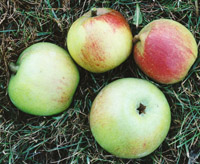 |
CELLINI
Raised and introduced around 1828 by Leonard Phillips, nurseryman of Vauxhall
Bridge, London and similar in appearance to Nonesuch, from which it was
probably bred, according to Hogg. It is medium sized, roundish and oval
with a flattened crown, in use in October and November. It has a deep
yellow skin, with patches of red on the shaded side and bright red with
streaks of darker red, where exposed to the sun. The flesh is tender,
very juicy and with a slightly balsamic aroma. Both father (George) and
son (Edward) Bunyard remarked upon its very regular crops, the latter
regarding it as its chief advantage 'but the curious flavour appeals to
some'. We have not noticed anything strong or disagreeable in the flavour.
It has been a popular cooking apple, producing a cream purée, but
it has a stronger claim to be a good dessert apple, crisp, juicy and sweet.
When underripe it has also been used as a cider ‘bittersharp’.
Pollination Group 5 |
|||
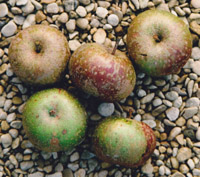 |
CHACELEY
KERNEL From Chaceley, a village area that straddles Worcestershire
and Gloucestershire. This is a small to medium to large sized dessert
apple, flattened round to oval, deep green with a brownish flush, overlaid
with large russet spots and sometimes quite red. Before fully ripe. it
is a useful cider ‘bittersharp’, as the flesh is very juicy
but can stay austere even as late as October. In some warm years it can
be a fully ripe and sweet, juicy dessert apple in September, with a rich
flavour, but often with the flesh remaining hard. The apples will last
until the year end. Pollination Group 4 |
|||
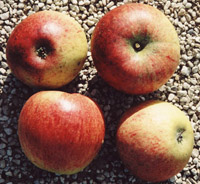 |
CHARLES
ROSS A medium sized, dual purpose apple raised by Charles Ross,
who was the head gardener at Welford Park in Berkshire from 1860 until
1908. He crossed Peasgood’s Nonsuch and Cox’s Orange Pippin,
and selected various apples as a result. Charles Ross was his first selection,
first exhibited in 1890 and given this name in 1899. It is lightly aromatic,
very sweet and juicy, with a firm texture, delicious to eat raw, and keeping
its shape when cooked. It will keep until December, but is best consumed
earlier. It is free spur bearing and said to do well on chalk soils. A
highly valued apple. Pollination Group 4 |
|||
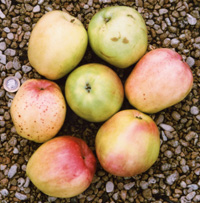 |
CHARLOTTE’S
LUCK Charlotte Aitken had lived in her bungalow at South Hykeham,
now subsumed by Lincoln, for 23 years and was curious about her apple
tree that had barely changed over that time. It produced such good apples
that she was curious to find a name for this apple and she sought our
help. She sent photos and, later, some apples, saying that her bungalow
was built in 1939 and that there had been apple trees in an unused field
next to her (now housing) and other trees in neighbouring gardens, now
mostly lost. She thought the bungalow was built in an old orchard. The
old Ordnance Survey maps show a ‘High Moor Plantation’ next
to her property but outside and maps from 1886 to 1948 show no orchard
trees or other trees on her patch. Charlotte mentioned that the Pennells
Garden Centre was just across the road from her (dating from the 1970s)
but Pennells Nurseries had a much earlier history in Lincoln, from the
mid- 19th century and still having their main nursery in Lincoln until
quite late. We wondered if her tree might have come from Pennells and
possibly whether Pennells had plantations of stock trees in the area of
South Hykeham. We contacted Pennells and the current owner Richard Pennell
was equally intrigued and very kindly sent us all the catalogues in his
possession, back to 1871. Alas, there was no apple listed, now lost to
knowledge, that could be Charlotte’s apple. Maybe the tree was from
a farm orchard, the farm long gone. The area around was formerly gravel
pits, now closed and made into a lake. The orchard might just have been
a bit of spare land used for an orchard while the few remaining trees
were still there, the owner just waiting to develop. This small field
was at the bottom of her garden. We might never know the original name.
We commissioned a DNA test and no match was found with anything else already
tested. The tree looks as if it once had a larger trunk, but is now four
trunks, two dividing from a trunk just above ground level. The apples
are the same on all four trunks and are ripe in mid to late September,
sometimes into October. The shape is oval to conical and sometimes long,
medium sized and yellow with a warm blush and red streaks. Dual purpose,
it is rich, sweet, juicy, crisp and fine textured with a hint of lemon.
Though slightly sharp it is very good to eat. When cooked it softens quickly,
keeps its shape, gives off no juice and is a perfect blend of sweetness
and acidity, with a very rich flavour. A very good apple even if a bit
of a mystery! Poll ? |
|||
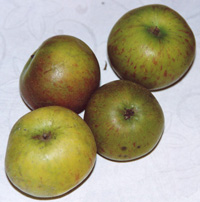 |
CHAXHILL
RED According to the Herefordshire Pomona of 1885- ‘A very
beautiful little Gloucestershire apple, which received a first class certificate
at Gloucester (1873) “for its excellence as a cider fruit”.
It was raised from seed by Mr. Bennett, of Chaxhill, Westbury-on-Severn.
Its juice, however, is poor and thin, and it has not therefore maintained
its character as a cider apple.’ Perhaps this was a harsh judgment
since it has continued to be a popular cider variety. The Gloucestershire
Orchard Group, who provided us with scions, deem it to be triple purpose,
but its value as a culinary or dessert apple is limited. The skin is deep
crimson in the sun, with darker streaks, and greenish-yellow, thinly streaked
with red in the shade. A cider ‘sharp’, that is ripe in September
and does not stay in good condition much beyond October. Pollination Group
6 |
|||
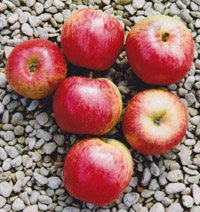 |
CHERRY
PEARMAIN An old apple, already well established in the Herefordshire
orchards in the middle of the 19th century. The first record was when
it was exhibited by Cranston Nursery, Hereford, at the National Apple
Congress of 1883. It has no known prior history. It was principally a
cider ‘sweet’ but Hogg records that it was also a good dessert
apple ‘sweet from the tree’ and will ‘make a good pudding’.
Medium sized fruit, usually roundish, but sometimes conical or angular.
It is a showy apple. The skin is completely covered with crimson, with
darker streaks, in the sun, but rich yellow, streaked with crimson, in
the shade. The flesh is yellowish, tender, juicy, sweet and pleasantly
flavoured, with mild acid. We do not find it particularly tannic, when
fully ripe. It was considered a mid-season dessert and culinary apple
in the National Apple Congress report, written by Barron, but an early
cider variety in the Herefordshire Pomona recommended cider list. There
appears to have been no knowledge of this apple variety after the 19th
century in Britain, but the late Nick Botner, in America, kindly sent
scions in 2006. It has pale blossom with deep pink reverses. Pollination
Group 5 |
|||
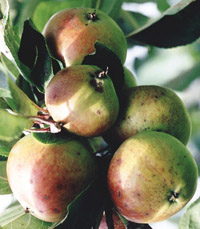 |
CHISEL
JERSEY The first reference to this cider apple was in the Herefordshire
Pomona of 1876-85. ‘A striped bitter-sweet apple in the highest
esteem in Somersetshire. It is a constant bearer and a free grower. It
makes excellent rich cider, of high colour, and if mixed with some rich,
sweet, kind, ripening at the same time, it becomes of the highest quality.’
It is said to have originated at Martock, Somerset. In Somerset and Dorset
it is still widely found from mass plantings in the mid 20th century.
A late season ‘bittersweet’ cider apple ripe in November.
It is medium sized, flattened conical, green skinned with russet, sometimes
flushed brown and with red stripes and sometimes with a large carmine
blush. It is a late flowerer and a precocious bearer. Pollination Group
5 |
|||
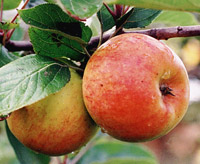 |
CHIVERS
DELIGHT This eating apple was raised by Mr. Chivers in 1920 at
Histon, Cambridgeshire. It has a sweet, gently acid taste with an interesting
honeyed flavour. The texture is firm, crisp and juicy. The moderately
vigorous trees are said to grow well in the north. An attractive, medium
sized apple with amber and orange flushes, streaked red. Crops are generally
good. Ripe in October, the apples will store until January. Pollination
Group 5 |
|||
 |
CHRISTMAS
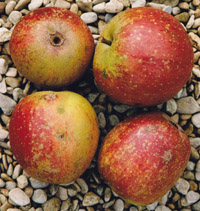
PEARMAIN This is not the heavily marketed, very modern, wilding
found by the roadside, called Christmas Pippin, to give it some aura of
antiquity. Christmas Pearmain is a very good, Kentish, late dessert apple,
introduced in 1895 by the famous nurseryman George Bunyard, father of
the pomologist Edward Bunyard. It was raised by a Mr Manser. The medium
sized apples have a uniform, attractive shape, often quite oval. The skin
of gold and green has russet streaks and is flushed and streaked red,
with numerous dots. The flesh is firm, juicy, pleasantly acid and sweet,
developing a very rich flavour in November and December. A small, compact
tree that produces good crops. Pollination Group 3 |
|||
|
||||