


| |
|||||
|
|
|
|
|
|
|
|
|
 |
 |
 |
|
||||||||
 |
||||||||||||
 |
|
|||||||||||
|
||||||||||||
 |
|
|||||||||||
|
||||||||||||
 |
|
|||||||||||
|
||||||||||||
 |
|
|||||||||||
|
||||||||||||
|
|
 |
 |
|
|||
 |
||||||
|
|
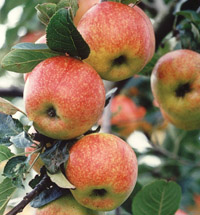 |
WOOLBROOK RUSSET Raised by Woolbrook Nursery of Devon, in 1903, from a cross of Bramley with a King's Acre Pippin. A flattish apple with golden yellow skin, streaked with scarlet, and lightly russeted. A late dessert apple with firm white flesh, juicy and developing a good flavour. With Bramley as a parent, it can also be used for cooking, keeping its shape and giving enough sweetness and acidity. Pollination Group 3 |
||
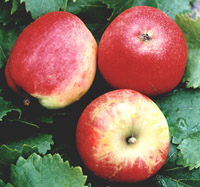 |
WORCESTER PEARMAIN A seedling of Devonshire Quarrenden grown by Mr Hale of Worcestershire, and introduced around 1873 by Richard Smith. It soon became very popular and by 1876 trees were selling for the extravagant sum of 1 guinea. Bright red, medium sized fruit, crisp and juicy, and with a strawberry flavour. Very sweet, and popular with children. Good crops in September, richer if left on the tree, but it does not store for long. Attractive blossom. Part tip bearing. Pollination Group 4 |
|||
WOTTON
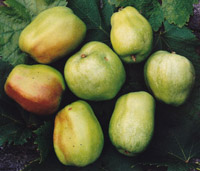
AUTUMN CARPET This tree is tall and upright, with a modest girth,
though the trunk is very weathered. It is hard to say if it is a seedling,
a sucker or a new trunk grown from a fallen tree. It looks to be 100 years
or more. This is the latest flowering tree in the orchard but others are
still in flower for pollination. Apples drop in mid-October and are still
intact on the ground in mid-November and into December. The apples are
of variable shape, small and sweet, without much acidity, a little tannic
and a bit dry. They start pale green and turn greenish yellow with an
occasional amber patch and a few streaks. It might be a useful bittersweet
cider apple. It is a very prolific cropper and might reveal other qualities
if pruned or grown on a younger tree. Now named 'Wotton Autumn Carpet'.
Pollination Group ? |
||||
 |
WOTTON
COSTARD An excellent apple from an ancient orchard at the nearby
Wotton Estate. Richard Ames and Carrie Fletcher found and brought some
apples to us. The orchard originally formed part of Thomas Lovell’s
cottage holding in the 17th century, but was separated by the enclosure
of Wotton (the first enclosure by private Act of Parliament in the country)
as the old village was removed, at the time when Capability Brown redesigned
the gardens. When he designed the new ‘pleasure gardens’ the
old orchard was left on the perimeter and was seemingly left almost untouched
for about three centuries. It still contains many old and interesting
fruit trees, among them two large trees of this apple, both of which fell
some years ago and re-rooted in the soft moist soil. They are very old.
The variety may be the Grey Costard of Parkinson or Costard of Scott.
It is not Catshead - the ribbing, waist to the fruit, flavour and keeping
time exclude it. The presumed extinct Costard is the second earliest English
apple to be recorded, in 1292. Parkinson mentioned the Gray and the Green
Costard (assumed to be the extant Green Custard). In the Herefordshire
Pomona of 1885 Hogg made a rare mistake in describing Grey Costard. He
mis-reported Parkinson by quoting that the “gray Costerd abideth
not the winter.” Parkinson actually said “The gray Costerd
is a good great apple, somewhat whitish on the outside, and abideth the
winter.” The Wotton Costard keeps until March, is heavily marked
with whitish patches and streaks, when immature, and matures to the image
of the Gloucestershire Costard in the Herefordshire Pomona. It is a first
rate apple, excellent for cooking, and which can be eaten for dessert
later in the season. It is heavily ribbed; the skin is greenish-yellow
but develops amber patches and red blushes and streaks on the side near
the sun. The firm, pale flesh is juicy, sweet, tangy and fragrant, with
a flavour which develops in richness when cooked. As a culinary apple
it keeps its shape, is excellent for pies and tarts and will also make
excellent sauces. The flowers are pink and white and very large. The trees
are regular, heavy bearers. Fully ripe in early November, the apples will
keep with careful storing into the spring. Pollination Group 4 |
|||
WOTTON
ENDURANCE Another of the trees in the Old Orchard at Wotton Estate,
the history of which can be seen on our website.This ancient tree is upright,
but is heavily decayed in the trunk and broken off at 8 feet. A new trunk
is growing from the side of the old trunk, where the limited living tissue
is still in touch with the roots. It is quite a unique apple! The very
hard, bright green fruit is quite inedible until the apples have over-wintered
on the tree and are then gathered in January or February, when they are
best stored for a while longer. The flesh before ripeness is without sharpness
or bitterness and only with a little sweetness. Eventually, they become
sweet, juicy enough and with a good flavour. As they mature the glossy
green skin becomes paler and with some warm blushes in the sun. Unfortunately,
we and Michael Harrison, the Estate Manager, have not been able to test
enough apples for long enough, thanks to the squirrels who make off with
them. We do not yet know their full virtues in cooking at the end of their
storing time. In early February, they keep their shape when cooked, with
a sweet lemony flavour. This apple might just be the long lost ‘Deux
Ans’ also called ‘John Apple’ and known to Shakespeare,
as it matches no other apple, sufficiently described. We can, of course,
never be sure. Now named 'Wotton Endurance'. Pollination Group 4 |
||||
WOTTON
ENIGMA Another of the trees in the Old Orchard at Wotton Estate,
the history of which can be seen on our website. A very old tree, fallen
over and rooted from the trunk. The vertical growth is now mature. The
old trunk had largely gone in the 1990s. The fruit is unusual, being irregular,
rather flat and very conical and of variable size, some over 3 inches
wide and 2-3 inches deep. The flesh is sharp and hard, but rich, in October.
In November it is sweeter, still sharp and with a strong flavour. By December
it is perfect – still juicy, rich and sweet but still a little too
sharp to eat raw. When cooked, it keeps its shape well and is powerfully
rich, sweet, very tangy and needs just a little sugar for perfection.
Now named 'Wotton Enigma'. Pollination Group 5 |
||||
 |
WOTTON
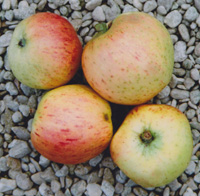
NECTAR Another of the trees in the Old Orchard at Wotton Estate,
the history of which can be seen on our website.This tree is upright,
mature and old, but of uncertain age. The apples are small and the blossom
is very attractive. Ripe at the end of August, into September, the flesh
becomes softish a few days after picking. Flesh is fruity, juicy, sweet
and crisp straight from the tree and would be very good for juicing. Now
named 'Wotton Nectar'. Pollination Group 2 |
|||
 |
WOTTON
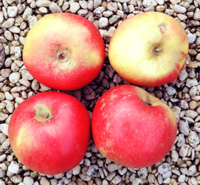
PROLIFIC Another of the trees in the Old Orchard at Wotton Estate,
the history of which can be seen on our website. A truly ancient tree
which fell over many years ago and re-rooted from the trunk. A new vertical
shoot is now mature. The original trunk when first seen had nearly disappeared
into the ground. Now, the signs of it have almost gone. Some fruit drops
in October but the main drop is in November. Medium to large rounded apples
with matt green skin with light red streaks in the shade but fully red
in the sun. An excellent, fine textured, crisp, dessert apple, with a
complex flavour when young, becoming richer. At the end of November it
starts to soften but the flavour is still good, sweet and juicy. It will
last well until the end of the year. Cooked, it softens quickly and keeps
its shape but would mash and is rich, and sweet, needing no added sugar.
It does not discolour when cut. One of the best in the orchard. Michael
Harrison, Wotton Estate Manager, named this Wotton Prolific as it always
bears well. Pollination Group 4 |
|||
 |
WOTTON
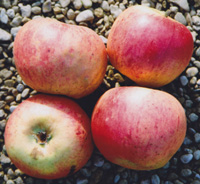
RESURGENT A fallen tree that had rooted from the trunk. The rootstock
had suckered significantly. A medium sized, flattened, round apple, ripe
in October to November. The skin is dull green, and russeted, becoming
amber with a warm blush and a few streaks. In October it can be a little
sharp, but it is also sweet with a good flavour. It is best in early November
when the flesh is tender and juicy. It will last to December and though
it tends to shrink and soften, it remains sweet, rich and juicy. Now named
'Wotton Resurgent'. Pollination Group 4 |
|||
WOTTON
REVIVAL A mature tree, possibly 100 years plus and upright. It
does not look as old as the rest and might be either a seedling that grew,
unmolested, or a regeneration from a fallen or decayed trunk, now gone.
A mature younger shoot from the base is the same as the rest, observed
from blossom and fruit. Waxy, small, pale green fruit, becoming yellow,
with a rare blush and few pale streaks in the sun, with warm brown russet
patches and nets. Fruit is ripe in October and is fairly crisp, fairly
sweet, with pleasant acid, juicy and tannic. It would probably make a
useful single variety cider apple. Now named 'Wotton Revival'. Pollination
Group 5 |
||||
 |
WYKEN
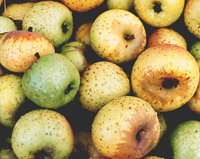
PIPPIN A late dessert apple dating from around 1700, and believed
to have come from a pip saved from an apple brought home from Holland
or France by Lord Craven, and planted at Wyken (pronounced ‘Why-Ken’),
near Coventry. Small, golden fruits, with fine russet dots and a very
fruity, intense flavour. Very popular in the 19th century. A well-shaped
tree, which produces regular crops. It stores until late winter. Pollination
Group 4 |
|||
WYVERING
When Karen and the late Mark Stanley-Price came to the small village of
Oddington, Oxfordshire, they had an old orchard attached to their property,
probably a farm orchard owned by the former farm across the road. Within
was this substantially old tree and we have mused upon it for several
years. A recent dna test by us came back with a match to Beauty Of Bath
but so did another tree close by and that did, indeed, appear to be Beauty
of Bath. The fruit is different and it would not make much sense for two
of the same variety to be planted. We have trees of both here. The apple
we are talking about, named Wyvering by Karen, after the very old field
name in which the orchard now stands, is very much redder in colouring
on the skin than Beauty of Bath and the apple is pink tinted under the
skin and in the flesh. Assuming the dna test was correct, and not all
are, we must conclude that this apple is a mutation of Beauty of Bath,
a state that the dna test could not reveal, as it does not look at genes,
only areas of repeated, inactive sequences. Like Beauty of Bath, this
apple is ripe in mid August, and is crisp when picked from the tree, but
soon goes soft. It is sweet but also tart. Unlike Beauty of Bath, which
is prettily streaked and flecked with red, Wyvering is darker red and
more fully coloured with red, sometimes in continuous flushes. Pollination
Group 3 |
||||
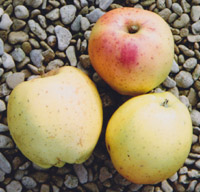 |
YELLOW BELLFLOWER An old American variety perhaps dating from the 1600s, first recorded by Coxe in 1817. He remarked that ‘the original tree is said to be now standing on a farm in Burlington County, New Jersey, very large and old’. By 1826 it was in the collection of the London Horticultural Society. Scott recorded that the name was ‘Frenchified’ to Belle-Fleur so as to appear French and it then attracted a lot of foreign synonyms. A late season, large dual purpose apple ripe in October and storing to February. Lindley described it as large and oblong, with an irregular outline and skin of pale yellow with a blush in the sun but often without. The eye is closed and sunk in an uneven basin, the stalk is slender and sunk in a deep plaited cavity. The seeds are large and the capsules very large so the seeds rattle in it when shaken. He adds ‘a most excellent apple’. In Philadelphia it was highly esteemed as their principal winter apple. It cooks to a richly flavoured, golden purée. Trees have a spreading habit. Pollination Group 3 | |||
 |
YELLOW
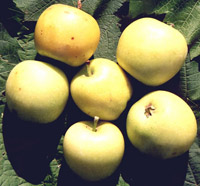
INGESTRE A dessert apple named after Ingestre Hall, the home
of Earl Talbot, though the original tree was raised by Thomas Andrew Knight
around 1800. The tree has small, regular, golden fruit, crisp with a very
rich flavour. It was once popular for garlands and table decorations.
The tree was also admired for its 'beautiful drooping habit' and pretty
blossom, and was much grown in the North as well as in Kent. The apples
are ready to pick in mid September, and store until the end of October.
Though this apple has been called Yellow Ingestrie for many years, Martin
Gadsbey of Stafford first pointed out to us that the original and proper
spelling of ‘Ingestrie’ was ‘Ingestre’, pronounced
in the same way. Pollination Group 3 |
|||
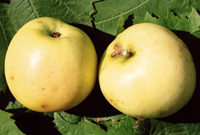 |
YELLOW SIBERIAN CRAB There appear to be three different Yellow Siberian Crabs. One is an ornamental modern variety sold by garden centres of unknown origin and using a name they should not. The next is the Yellow Siberian, bred by Thomas Andrew Knight, the famed Pomologist of the late 18th and early 19th century. According to Taylor (1946) it was raised in 1805. Loudon (1822) says it was raised from a cross of Yellow Siberian Crab and Loan’s Pearmain. It was cider apple and one of several that Knight bred with Yellow Siberian Crab as one of the parents. Thus we move to the third Yellow Siberian Crab. The one he bred from. No living examples of these two old Yellow Siberians have not been known in Britain for two centuries. Loudon tells us that the Yellow Siberian bred by Knight was small and round. The one we have is more medium sized and a little irregular. We found it listed in the Grove Collection in Tasmania and received scions from there in 2005. Until it fruited, we did not know quite what we had. We now think it is the Yellow Siberian Crab that Knight bred from and probably the ‘Malus Baccata, Yellow-fruited, Large or Amber Crab’ of Scott (1872). Modern knowledge seems to have passed this apple by. This apple is medium sized, yellow, with slightly woolly, hardish, astringent and tannic flesh, overlaying some sweetness. Its only use can be for cider or as breeding stock. It seems very hardy, as would be expected, is ripe in September and will keep for a month. Pollination Group 4 |
|||
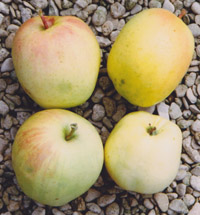 |
YELLOW WAXEN An excellent and rather attractive apple, whose origin is something of a mystery. It appears to be either British or American, but the truth might never be found. In 1871, an apple called Yellow Wax was noted in the Journal of the Royal Horticultural Society, but the only information given was that the apple was ‘middle season’. There are no other references that we have found in the literature, either side of the Atlantic. We found it listed in the collection of Nick Botner, in Oregon, and wondered whether it might be an example of several British apples that found their way to America while becoming lost here. We grafted the first new trees here in 2009. It is certainly a middle season apple and aptly named. The fruit has an evenly rounded shape, skin of attractive pale lemon, with a faint flush of amber, prominent dots and a waxy bloom over the whole. Medium to large, ripe in mid September, crisp, juicy, sweet, lemony and refreshing with a slightly balsamic flavour. It will last into December and still be pleasant, but is at its best earlier. A very good apple, for our climate, where it might have originated. Pollination Group 5 | |||
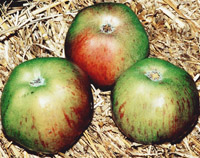 |
YORKSHIRE
GREENING An old cooking apple very popular in Yorkshire, first
listed by William Perfect of Pontefract, in 1769. Forsyth described it
thus: ‘The Yorkshire Greening, is a good-sized flatted Apple, of
a dull-red colour, with a little green towards the eye. It keeps till
August’. (August the following year). It cooks to a sharp, rich
purée and has also been used as a cider sharp. The large, ribbed
apples are dark green and colour up with brown red streaks and darker
red in the sun. They are flecked with dark brown russet. The flesh is
crisp, very juicy, 'with a brisk but pleasant acidity', according to Hogg.
He suggests it only lasts to January. The trees have a dwarf and spreading
growth. Large flowers. T*. Pollination Group 4 |
|||
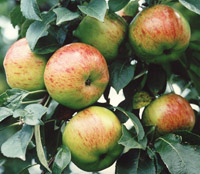 |
YOUNG’S PINELLO A medium sized dessert apple, raised sometime before 1935 by Miss E.L. Young at Letchworth in Hertfordshire. Ribbed, with pale yellow skin and red stripes. The white flesh is crisp, juicy, sweet and fragrant. Pick early to mid-October and store into December, when the texture and flavour are still good. A very regular and reliable cropper. Pollination Group 3 | |||
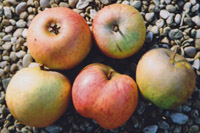 |
ZABERGÄU
RENETTE Raised in 1885 in Baden-Württemberg, southern Germany
and widely grown throughout Europe, including Britain. An excellent dual
purpose apple. The apples are a warm gold when ripe, with russet patches
and tawny scarlet streaks. The flesh is yellow, with a good blend of sweetness
and sharpness. A good cropper with very attractive blossom. Ready for
picking mid October, storing into March. T. Pollination Group 3 |
|||