


| |
|||||
|
|
|
|
|
|
|
|
|
 |
 |
 |
|
||||||||
 |
||||||||||||
 |
|
|||||||||||
|
||||||||||||
 |
|
|||||||||||
|
||||||||||||
 |
|
|||||||||||
|
||||||||||||
 |
|
|||||||||||
|
||||||||||||
|
|
 |
 |
|
|||
 |
||||||
|
|
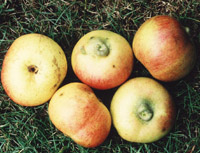 |
BELVOIR SEEDLING Existing before 1935 when it was received by the National Fruit Trials, it was raised by W. H. Divers, probably at Belvoir Castle, Leicestershire, as a cross between Annie Elizabeth and Dumelow’s Seedling. A medium sized dual purpose apple, in use from October to April. Flattened round, sometimes ribbed at the open and distinctive eye and often with a fleshy protuberance at the stalk. The skin is yellow, flushed brown and red with some russet and dots. The flesh is firm, fine and yellowish-white with a sweet, subacid flavour. It cooks to a lively purée. Scions were sent to us by John and Helen Hempsall, fruit enthusiasts of East Markham, Nottinghamshire. Pollination Group 5 |
||
BEN’S RED This apple was raised around 1830 by Benjamin Roberts, of Trannack, Penzance, Cornwall, and became well known, locally. History records that it was a cross between Devonshire Quarrenden and possibly Farleigh Pippin, (though Taylor says Farleigh Beauty). It was also very popular in Devon and Gloucestershire and even grown in Ireland. A medium sized dessert apple with pale yellow skin, often almost wholly covered with red, and with darker red streaks. The fruit can sometimes be small or quite large. The crown is flattened and there is usually russet around the stem cavity. The flesh is sweet, crisp and yellowish, sometimes tinged red. Taylor says it is devoid of any special flavour, though the ‘Irish Seed Savers’ organization report a marked strawberry or raspberry flavour. Ripe in September, it is well known as a good cropper and once a valued market fruit. The trees are dwarfish but sturdy and it is known to root fairly easily from cuttings. It is still grown at Wisley and at Brogdale. Poll 5 |
||||
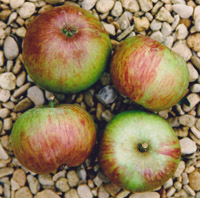 |
BERKELEY
PIPPIN Presumed originating at Berkeley, Gloucestershire, and
known at the start of the 20th century, when considered a cider variety.
Though it tends to have a little tannin, in the flesh, it is actually
a good dessert apple, medium sized, flattened round, often conical and
irregular. It is often quite late to ripen fully, late in October, and
carries a heavy bloom over a prettily striped apple,. The flesh is sweet,
crisp and juicy. The apples are better in November and can be stored to
the year end, though becoming drier. Scions were sent to us by the Gloucestershire
Orchard Group.
Pollination Group 5 |
|||
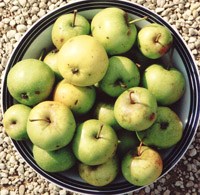 |
BERNWODE
CRAB Malus Sylvestris. Wild Crab. The Wild Crab is either a British
native or colonised Britain shortly after the Ice Age. The sour fruit
has long been used for a variety of purposes, including the making of
Verjuice, a fermented liquor, used in cooking and preserves and to cure
ailments. It was also planted as a foodstuff for livestock. The Bernwode
Crab is a very old tree in our ancient hedge, lining a mediaeval, perhaps
Roman, drove road. Trees are grafted on to MM111 and MM106 only and will,
by their nature, become small trees with a shapely and spreading habit.
Small yellow fruits, sometimes with red streaks, are ripe in late October
and hang on the tree for several weeks. They can be stored over the winter.
Pollination Group 3 |
|||
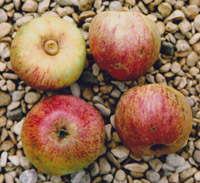 |
BESS
POOL Named Bess Pool after the daughter of an innkeeper. She
found this wild seedling, laden with fruit, growing in a wood in Nottinghamshire
around 1700. It became popular locally after she brought the fruit back
to her father’s inn. Later it was nationally known and much valued
in the nineteenth century, following its first formal recording in 1824
and marketing by Pearson's Nurseries of Chilwell, Nottinghamshire. Ronalds
(1831) ascribed it to Warwickshire, while Loudon in 1820 called it ‘A
Welch Apple’. A crisp dessert apple, with medium-sized fruit, heavily
marked with crimson and with a rich flavour. It may also be used for cooking
and for cider. Apples keep until March. The trees have a good shape. Partially
tip bearing. Pollination Group 7 |
|||
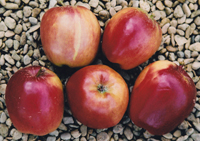 |
BEVERLEY
APPLE An impressive cooking apple of great beauty, and one of
those rare discoveries that appears to have no written history. Liz Carter
of Burton Neston, in the Wirral of Cheshire, approached Pete Steepe, of
Burton Manor, to identify her unusual old apple. He was very impressed
with it and passed the details to us for our opinion. It was quite obviously
different to any we have seen. Liz has provided us with a full provenance.
The earliest known tree was growing in the garden where Liz was a child
over 70 years ago, in Beverley, East Yorkshire. The house had been sited
in the gardens of Lairgate Hall, which was built around 1700, probably
by the Walker family. The garden/estate was sold off for housing in 1938
and a major road now passes through it, the site being fully developed.
On returning, a few years ago, Liz found that the old tree had gone. When
her family moved to Cheshire, her father had brought and planted this
apple, currently in her garden, and Liz observed that it was such a good
cooking apple that it was surely passed from garden to garden and other
examples might still exist in Beverley. “The apple has such a delicious
flavour – much tastier than my Bramley”. It is a medium sized
apple, beautifully dark red, with a glossy, waxy skin, long and tapering
and ripe in late September, when it cooks to an excellent sweet and rich
purée, though it will keep some shape if cooked lightly. It does
not last much past the end of November, without decaying from the inside
and becoming bland and cidery in taste. It is also one of those types
of apple (called Burr Knot or Pitcher) that will readily root from cuttings.
In these cases, cuttings were usually passed around and trees appeared
in numbers, locally. It is a great surprise that this excellent apple
has not been noted before. Our thanks to Liz Carter and Pete Steepe for
keeping it going and telling us all about it. Pollination Group 5 |
|||
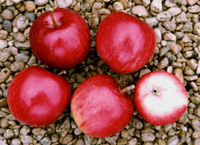 |
BLACK
CROFTON Included here, only for the name, as it has no known
history of cultivation in Britain or Ireland, though there is reason to
believe it is of the same family as Crofton Pippin and Scarlet, White
and Brown Crofton, whose origins appear to be English or Irish. Black
Crofton has only been known in America in modern times, but we now have
it back with us. In America it was assumed to be a cider variety but with
us it is a good eating apple. Whether the old English Crofton family brought
apple varieties to Ireland or whether they bred or adopted them in Ireland
will probably never be known. The apples might even have been French in
origin. They have been assumed Irish. The name comes from the Croftons,
an English family, though it is uncertain which generation of the family
first owned the trees. The Crofton Estate in Ballymurray was first granted
to John Crofton by Elizabeth the 1st. He was appointed Auditor General
in 1584 and owned several estates. He arrived in Ireland with the Earl
of Essex in 1576 and stayed until 1597. In 1661 Edward Crofton became
a baronet for services to the future Charles II, during the Cromwell revolution.
The first suggestion of the origin of Crofton apples comes from the name
‘Longford’. Longford House was owned by the Croftons - first
mentioned in the 1600s - and Longford Pearmain is a known synonym of Scarlet
Crofton in Lamb’s book ‘The Apple in Ireland’. In 1951
Sir Henry Crofton confirmed to Lamb that the apple ‘Scarlet’
was brought to Ireland during the time of Queen Elizabeth I, by the first
known generation of the Crofton family, ie John Crofton. A late season
apple of medium size, quite regular and round and ripe in October. The
flesh is white and fairly dense, but very crisp and extremely juicy. The
apples are sweet and with a pleasing flavour that is hard to describe.
We find no tannic that would mark it out for a cider fruit. An excellent
eating apple and a very attractive fruit. Poll 5 |
|||
 |
BLACK
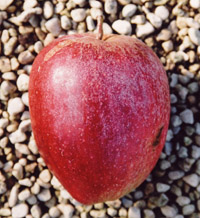
GILLIFLOWER This old apple is English, though most of its known
history is from America where they, wrongly it turns out, have considered
it to be American. It has been described well in many old American reference
works. A piece of good fortune unlocked the mystery. It has been known
since the early 1700s in America and old trees are still found in the
South. However, several old trees have been found around Bledington, Oxfordshire
and towards the Cotswolds. We retrieved Black Gilliflower from the US
Department of Agriculture collection in 2005. We had also received scions
of an apple, identified by Sarah Juniper as Lady’s Finger of Hereford,
and grew that here too. When both fruited at the same time we discovered
them to be identical. (The Lady’s Finger of Hereford we now supply
is the correct one) The scions we received of this so called Lady’s
Finger of Hereford were from Bledington in Oxfordshire. Philip Rainford,
(who for many years has researched many old fruits of Lancashire and Cumbria)
has recorded that a gentleman called Albert Harris, living in the Cotswolds
in the 1940s, was very aware of old trees locally around Bledington which
were called Lady’s Fingers. He thought they were planted around
the middle of the 19th century, though they could have been much older.
He grafted and distributed trees. In modern times the variety has been
given the name of Lady’s Finger of Bledington. However, since we
now know it is the same as Black Gilliflower, which has no known history
of having been grown in Britain under that name (though Gilliflower is
such an English word) we must now assume that Black Gilliflower finally
has some evidence of being an English, not an American, apple. It presumably
lost its name here in centuries past and became known as Lady’s
Finger locally. Since Black Gilliflower is the first name, this is the
one we retain, as being correct. A sweet, crisp, moderately juicy dessert
apple, with dense flesh, richly flavoured. The shape is distinctive and
showy, quite elongated and narrowing at the eye. The skin is green, becoming
entirely covered with a dark plum colour in the sun. Ripe in October,
it is best picked as late as possible. It stores until February but is
best in November. A very good rich apple, though the flesh can be a little
short of juice. It has deep rose pink, stripy blossom. Pollination Group
3 |
|||
|
||||