


| |
|||||
|
|
|
|
|
|
|
|
|
 |
 |
 |
|
||||||||
 |
||||||||||||
 |
|
|||||||||||
|
||||||||||||
 |
|
|||||||||||
|
||||||||||||
 |
|
|||||||||||
|
||||||||||||
 |
|
|||||||||||
|
||||||||||||
|
|
 |
 |
|
|||
 |
||||||
|
|
 |
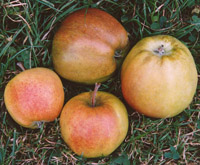
SUSSEX SLIP APPLE In 2016, Fiona Denman, a retired District Nurse from West Sussex, but now living in Scotland, told us about this very interesting apple and sent us wood to produce new trees. In the 1960s, Fiona was given three ‘slips’ by a friend at 26A Hillside, Horsham. He had an old tree in his garden (which might still be there) and he would eat an apple with boiled bacon, each morning, for his breakfast. The word ‘slip’ is most commonly used to mean a cutting from a garden plant, to be rooted. This apple is one of those sometimes called a ‘burr knot’ or ‘pitcher’, denoting one of the few apple varieties that will root from cuttings, while most need to be grafted. Such apples were often passed around widely to friends and neighbours. Fiona tells the story “an old woman was wanting to thank someone for a kindness and gave them her stick and said to plant it!” It is a similar tale to that of Mr Bide’s Walking Stick and the variety Burr Knot. Fiona’s father was a respected horticulturist and he also had a Sussex Slip Apple, much earlier, when working at Warnham Court near Horsham, where other old apples were grown in the orchard. This apple might still be there. When Fiona moved to Scotland, 25 years ago, she took her apple tree with her and still enjoys the fruit in her mid 80s. She also told us of a tree of this apple where she once lived at the old Post Office in Broadbridge Heath and probably another at Barton, Cowfold, both in Sussex. Perhaps these trees also still exist. One year, in Scotland, Fiona put some apples aside for storing and forgot about them, only to rediscover them in October the following year. They were still in acceptable condition. This is probably the only record of an apple lasting that long, albeit they were in Scotland. The apples ripen in late October with us. The flesh is fairly dense, fine, cream, not over juicy but enough, crisp to bite, sweet and with a rich slightly floral flavour. The acid is lively but the apples become sweeter with a little storage. It is a perfectly good eating apple, and is also good for cooking, when it softens fairly quickly and keeps its shape. The taste is rich but some will want to add sugar, for a full experience. A very useful apple. Pollination Group 5 |
||
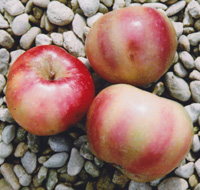 |
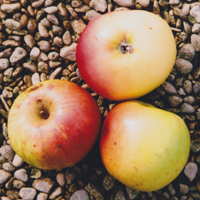
SUTTON SUNSET Near Pulborough, in Sussex, is the village of Sutton, where Fiona Wallace rented a house, before moving to Tasmania, she was struck by a rather unusual apple tree in the garden and having enjoyed the fruit greatly during her tenancy she told us about it from her new home in Australia. She told us that the tree flowered deep pink and that the leaves were copper coloured, while the apples were stained deep magenta throughout. We initially thought it was just another seedling of the Russian Crab, Malus Niedzwetskyana, which has red stained wood, deep pink blossom and apples with red flesh. However, her further description marked this tree out as being a bit special. The fruit when young and the size of large marbles already had deep red skin, flesh of deep magenta throughout, but even at this size were quite sweet, which is not typical of Malus Niedzwetskyana progeny, which are sharp, even a little bitter. Later, when the apples of this tree become medium sized they are still sweet and crunchy, good both for eating or cooking. We wrote to the address Fiona gave in the hope that the current owners would respond – and they did. Robert and Avril Southwell were also intrigued by their tree and were very enthusiastic, sending apples and photos. The tree, in the nature of its growth, clearly has a bit of another species of apple in its origin, as well as Niedzwetskyana and the domestic apple, Malus Domestica. The apples which Robert sent in the latter part of September, though not large and the best that were available that year, were very interesting. One was quite red skinned, while others had very broad but vague red stripes, uniformly spaced around, over a translucent pale green. The apples were red fleshed at the core and close to the skin. We found that the flesh could be just a little dry when fully ripe, but were mostly juicy, sweet and with gentle acid. The flavour was rather good for such a strange apple. Avril Southwell named it Sutton Sunset because their tree faces west and they get good sunsets there, illuminating the already warm tones of the tree, as the dying sun passes through. Given the stunning dark pink blossom in Spring, this mysterious tree has a lot to commend it. We are very grateful to Fiona, Robert and Avril for all their help in giving it a wider audience. |
|||
 |
SWEET
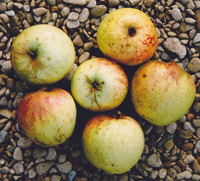
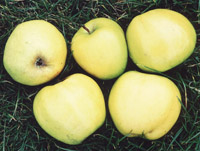
COPPIN An old Devon cider apple, also favoured in Somerset. It
is thought to date back to the early 18th century and was notably popular
in the Exeter area. It is a ‘Sweet’ in cider terms, making
a very gentle cider. The apples are medium to large with green skin, becoming
golden, with occasional flushes and dark red spots, ripe towards the end
of October and can be stored into the New Year. The flesh is very sweet
and juicy, and only mildly tannic, which does not interfere with it being
an enjoyable dessert apple. The trees bear prolifically and the fruit
is quite pretty. Middle flowering. Very dark buds contrasting with very
pale flowers. Pollination Group 4 |
|||
 |
SWEET
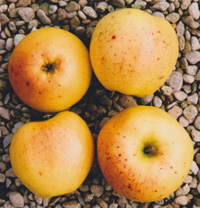
LADING First recorded in the London Horticultural Society collection
catalogue of 1826, it was described as a cider variety in the 1842 catalogue.
Hogg, in 1884, said it was used for cooking and cider, though probably
best for cider. At the Apple and Pear conference in 1934 it was considered
a culinary apple. It has also been an acceptable eating apple, but it
is probably too blandly sweet for most tastes. Hogg said it was common
in East Sussex and Kent. Medium sized fruit, roundish, and with some ribs
around the crown. The skin is green-yellow in the shade, but ripening
to bright yellow, with a few broken streaks of crimson in the sun. There
are traces of thin cinnamon russet. The flesh is white, firm, not juicy,
and very sweet, but with no acidity. Hogg suggested that, if used alone,
it would probably make very sweet cider. Ripe in November. Pollination
Group 3 |
|||
 |
SWEET
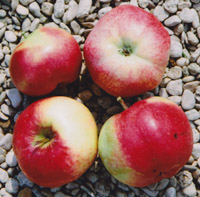
MARTEN The Polecat Public House, at Prestwood, Buckinghamshire,
contained several old and interesting apples in its extensive orchard
garden, and we took scions of all, with the permission of the former owner,
John Gamble, in 2005. Unfortunately the new owners have removed most of
the trees to enlarge the car park.The fruits bore all the hallmarks of
varieties planted to provide both food and cider for the old Inn’s
guests. The trees were at least a century old and many very old. We have
named them after the Mustelid family of creatures. Sweet Marten is really
a cider bittersweet apple, though it only has mild bitterness and is the
sort of apple that children would relish to eat, being very sweet. There
is almost no acidity. Ripe in late September, the flesh is initially firm
to crisp but soon becomes a little dry and crumbly. Pollination Group
5 |
|||
 |
SWEET
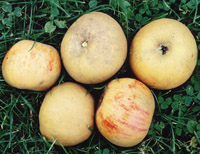
WILLIAM An Irish Apple, recorded by Lamb, the famous Irish pomologist,
in 1897. It was said to be a second early season, medium sized, round
apple with creamy yellow skin and red stripes and stippling. The flesh
is crisp, very white, very sweet and the tree has an upright growth. That
is exactly what we have discovered from the tree grown from scions sent
in 2003 by the late Nick Botner from his collection in Oregon. It is a
very pretty apple, quite delicious, rich, sweet, juicy and very crisp,
though Lamb said it was only sweet and not much else. Though this apple
is ripe as early as August, it will keep, albeit going a little tough,
with its sweetness and flavour intact until mid-November. If this is the
original Irish Sweet William, it has not been encountered for many decades,
but has now returned. It is a very good early season apple. Pollination
Group 3 |
|||
 |
SYKEHOUSE RUSSET First described in 1818. Originally from Sykehouse in Yorkshire, though locally it was believed to have been bred from a Portuguese apple planted at Pontefract. Small golden apples, sometimes with patches and streaks of red, with some russet, and crisp, juicy, yellow flesh, sweetly flavoured. A late dessert apple, storing until February. Good crops. Pollination Group 3 |
|||
 |
T.
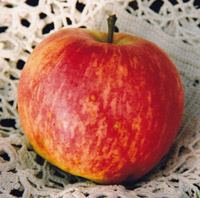
ROY SPARKES Scions were given to us by the late Canon Donald
Johnson, who learned of this tree from T. Roy Sparkes, an aged gentleman
who sent him wood in 1992. He lived at Weeke, Winchester, Hampshire and
said this old tree was in an area where there had once been a farm and
old fruit trees, before houses were built all around. Mr Sparkes said
the tree now dropped its apples on the pavement around the homes. It was
said to be like Miller’s Seedling, early, sweet, juicy and not keeping,
but we have found it to be more middle season and larger. It is a pretty
apple with green skin, becoming pale yellow, beautifully marked with broken
stripes of crimson. The flesh is sweet, crisp and juicy with a refreshing
flavour. Ripe in September and lasting in good condition for a month.
Spur bearing. Rich rose pink petals. Pollination Group 4 |
|||
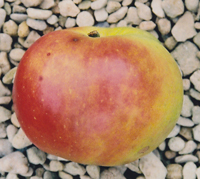 |
TARNSIDE
RED Mr Gibson had an old orchard at Tarnside, between Windermere
and Kendal, Westmorland. His orchard included the ‘missing’
Fallbarrow Favourite. When Hilary Wilson of Appleby-in-Westmorland visited,
she found that an old tree had blown down and that Mr Gibson had chopped
it up for firewood. He said that it was an anonymous good red eater. Hilary
Wilson found a pile of twigs and took some, which were still green and
vital, saving the tree from extinction. She sent some wood to us, several
years ago, now. It was well worth the saving since it is very colourful,
mostly covered in bright red, and is a very good dessert apple. Medium
sized, crisp, juicy and with a fine flavour, it does not appear to be
any known named variety that we can match it with, and it also defies
naming in the North-West. We have therefore, jointly with Hilary and the
South Lakes Orchard Group, named it Tarnside Red. Mid to late season and
spur bearing. Pollination Group 5 |
|||
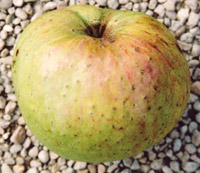 |
TAYLOR’S
FAVOURITE A good old apple found by Hilary Wilson in an orchard
in the Lyth Valley, Westmorland. The orchard contains several interesting
old and mostly anonymous varieties. It is owned by Desmond Holmes whose
family settled at Whitebeck in 1747, and still sold fruit to the market
until the 1960s. This apple is an excellent, sweet and rich dessert apple
but a little too large for the mouth. The firm but yielding texture is
also more like a culinary apple. When cooked it softens but keeps its
shape completely, developing a rich tangy flavour, with no need for sugar.
Ripe at the end of September in the South. Late into leaf. Pollination
Group 5 |
|||
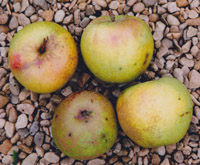 |
TAYNTON
CODLIN Not really a codlin, as these were generally cooking apples
ripe early in the year. A triple purpose, medium to large, conical apple
with straw yellow skin, sometimes netted with russet and sometimes with
a rosy blush. It was found at Griffin’s Farm, Tibberton, before
1954, and is common in Taynton. It is also known locally as Cow Apple.
A late season, sweet and sharp, culinary apple, lasting to the end of
the year. The flesh is firm and fairly dry, rich and sweet. It keeps its
shape and is useful for mincemeat, preserves and pies. When stored for
a while it is a very good dessert apple, with tender flesh, fairly juicy,
sweet and with a nutty, caramel flavour. Pollination Group 5 |
|||
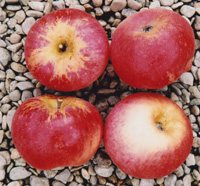 |
TEBWORTH
COBBLER Over a decade ago, Ian and Lyndie Lothian of Tebworth,
a hamlet in Bedfordshire, brought us some wood from an old apple tree
so that we could graft a new one for them. The tree grew in their 1640s
cottage garden and was clearly very old but of uncertain age. We provided
that new tree and kept one here for ourselves, since it seemed of significant
interest. With unmatched dna, it needed a name and Ian and Lyndie decided
on Tebworth Cobbler, because their cottage was once owned by the local
cobbler and when they came, 35 years ago, the garden was full of the cobbler’s
spent heel and toe plates and other paraphernalia from his craft. The
small to medium sized apples are ripe from late September to October,
flattish and bright red over pale yellow. Crunchy rather than crisp, but
juicy, these apples are very sweet and with a very rich taste, with a
hint of banana. They will last into November but are poor by the end.
A very enjoyable eating apple. Pollination Group 5 |
|||
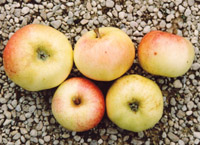 |
TEIGN HARVEY An old Devon cider apple which appears to have disappeared from history without leaving a reference. We came across the name in the US Department of Agriculture collection at Geneva, New York, the name suggesting a cider apple from the Teign valley in Devon, though there was no historic record of its existence. Some research revealed that there used to be a Teign-Harvey Farm in Stoke-in-Teign-Head, close to the coast, just south of the Teign estuary. Norman Howard, an 80 year old retired farmer of the area, knew the farm and reported that little of it remains. While he believes there are no cider trees there now, he recalls cider growing in the area between Shaldon and Combe Cellars from his youth. He also recalls visiting a farm in Totnes, where the farmer spoke of Teign Harvey apples. USDA received the variety from England in 1949, and we received it back in 2005. It is undoubtedly a cider apple, a free spur bearer, which fruits young and abundantly. The medium sized, sometimes large apples are flat, round and obscurely ribbed. The skin is a waxy yellow with only traces of russet lines near the stem and eye. The skin develops a warm blush in the sun. The eye is closed with erect segments in quite a deep basin. The stalk is very short and stout. The flesh is hard, not that juicy, moderately tannic and sharp, with some sweetness. Very dark blossom buds. Pollination Group 5 | |||
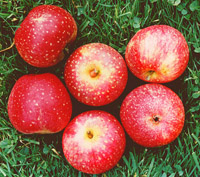 |
TEN
COMMANDMENTS It is so named because, when halved, transversely,
the fruit displays ten carpel threads, and a core stained red. A small
to medium sized, mid season apple, the skin heavily streaked with red
and with sweet, spicy flesh. A dessert apple that is also used for cider.
It is still grown in Herefordshire. Pollination Group 4 |
|||
|
||||