


| |
|||||
|
|
|
|
|
|
|
|
|
 |
 |
 |
|
||||||||
 |
||||||||||||
 |
|
|||||||||||
|
||||||||||||
 |
|
|||||||||||
|
||||||||||||
 |
|
|||||||||||
|
||||||||||||
 |
|
|||||||||||
|
||||||||||||
|
|
 |
 |
|
|||
 |
||||||
|
|
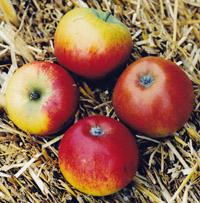 |
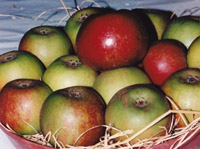
BEAUTY OF BEDFORD A mid-season dessert apple, raised by Laxtons of Bedford in the early twentieth century. It was said to be from a cross between Lady Sudeley and Beauty of Bath. A very colourful, medium sized fruit, with a crisp texture and good, sweet flavour. Ripe in September, it will store for a month or so. Pollination Group 4 |
||
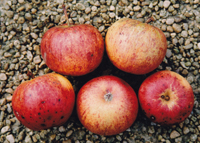 |
BEAUTY OF FRINGFORD One of three old apples growing in a small orchard at the Old Rectory, built in 1680, in the pretty village of Fringford, Oxfordshire. They were brought to our attention by the owner, Charles Hebditch, and none of these apples appear to be varieties currently known. Fringford owes some celebrity to it being the fictional ‘Candleford Green’ created by Flora Thompson in ‘Lark Rise to Candleford’. She lived at Fringford and worked in the post office there, in her early adulthood. This small dessert apple is prettily and heavily streaked with crimson and is ripe in early October. It is very juicy, sweet and quite fragrant, with the rich flavour of pear drops. Acidity is modest. A very tasty apple, which keeps its flavour if stored into November, but tends to shrink. Pollination Group 5 |
|||
 |
BEAUTY
OF HANTS A seedling of Blenheim Orange, raised near Southampton,
Hants, by Mrs Crabbe in her garden at Bassett before 1850. It is similar
in appearance to Blenheim Orange but is redder and sweeter. This late
dessert apple has sweet, firm flesh and stores until January. Being more
freely spurring than Blenheim, it is a better option for espaliers and
cordons, but the apples can be significantly larger than Blenheim and
might be too heavy unless espaliers and cordons are well supported. T*
Pollination Group 4 |
|||
 |
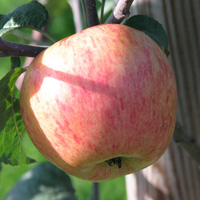
BEAUTY
OF KENT A late culinary apple, known since 1790. It was a firm
Victorian favourite on account of its large size. When cooked it keeps
its shape, needs no sugar and is very rich. After brief storage it is
sweet enough to eat as a dessert fruit, and in some years it is an excellent
dessert apple when first ripe. The blossom is very large and rosy pink.
One of the very best cooking apples, which crops well. T*. Pollination
Group 4 |
|||
 |
BEAUTY
OF WILTSHIRE There is much history to this apple – or apples.
Dredge’s Beauty of Wilts dates from the middle of the 18th century.
Some have considered it a renaming of Harvey’s Pippin (wrongly),
which was even older. Then there is Beauty of Wilts, which first appears
under this name in 1826. The London Horticultural Society catalogues of
1826 to 1842 consider them to be different. The latter is described (mostly)
as green with a red flush, similar to Blenheim Orange and principally
for cooking. The former is an eating apple, also useful cooked, and is
pale yellow with red spots and flecks. Space does not permit the detailed
and fascinating story of the view that was taken of – for and against
– Mr Dredge and the confusion with Harvey’s Pippin. Suffice
it to say that the record of Beauty of Wilts is patchy, inconsistent and
not particularly trustworthy, while the descriptions of Dredge’s
Beauty of Wilts are full. Through both confusion and neglect, Dredge’s
Beauty of Wilts, Harvey’s Pippin and Beauty of Wilts were all lost
in these Isles, in the 19th century. However, an apple called Schöner
Von (or Aus) Wiltshire has existed, in plain sight, in Germany ever since
its migration there. It is surprising that no-one has thought to bring
it back. It is known there with the synonym of Beauty of Wiltshire and
though its origin has incorrectly been attributed by them to John Standish,
apple breeder of Ascot, Berkshire, around 1880, it appears to be Dredge’s
Beauty of Wilts. It is a medium sized, eating apple, ripe in November,
with skin of pale yellow, dotted and streaked with red, and with slightly
spicy, sweet and juicy flesh. One of the several authors on Dredge’s
Beauty of Wilts, Loudon, in ‘An Encyclopaedia of Gardening’
in 1822, said that it was raised in ‘say’ 1750, was about
medium size or above, oval, bright yellow, spotted with red, ripe from
October to March, firm and juicy, a great bearer and “one of the
best apples yet known in point of general utility”. It is well regarded
in Germany too. Matthias Buchta of Bavaria kindly sent us scions in 2019,
his stock originally from the Julius-Keuhn Institute, and we now have
it back where it rightly belongs. Though we call it Beauty of Wiltshire,
a direct translation from the Gerrman, it seems to be Dredge’s Beauty
of Wilts and not the green, red flushed cooking apple called Beauty of
Wilts by others in the past. Dredge’s Nursery at Wishford, Wilts,
was highly regarded in the mid 18th century but when the London Horticultural
Society classified Dredge’s Beauty of Wilts as being the same as
the old Harvey’s Pippin (seemingly wrongly), it encouraged the belief
that Dredge was presenting older apples as if they were his own. Hogg
(1851) and Scott (1872) both made attacks on the authenticity of Dredge’s
work. However, Rogers (1837) said “This apple, as before noticed,
has been confounded with Dredge’s Beauty: but the author is certain
they are decidedly distinct. The Harvey’s pippin was in existence
in this country before Dredge’s time; and as Dredge himself informed
the author, above forty years ago, he raised his Beauty and two others
from the same sowing, both perfectly different from the Harvey’s
pippin.” Even Scott described both Dredge’s Beauty of Wilts
and Harvey’s Pippin in his ‘The Orchardist’ of 1872,
somewhat differently. The scandal might have led some to drop the ‘Dredge’s’
from the name, or perhaps another Beauty of Wilts came into being –
a cooking apple. The apple we now have back seems to be Dredge’s
Beauty of Wilts. |
|||
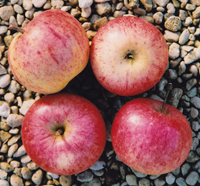 |
BECKLEY
BELLE An old tree, by itself, in the garden of Rick and Ali Kealy,
on the High Street of Beckley village, near Oxford. A medium sized eating
apple, ripe between the end of September and early October, with crisp,
crunchy flesh, sweet, with just the right amount of acid and with a trace
of banana flavour. In a normal autumn and winter it will last to the year
end. Quite an attractive apple and seemingly a very good bearer. Named
by Rik and Ali, as attempts at identification with any known apple were
exhausted. Pollination Group 4 |
|||
 |
BECKLEY
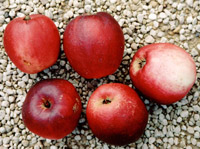
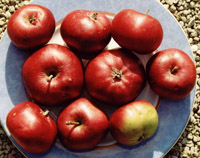
RED - There are two quite different Beckley Red apples, which were unknown
to any except the owners, until 2006, when we discovered both in the same
day. They are in adjacent gardens in Horton cum Studley, close to Oxford.
The village of Beckley is two miles away but the name, despite enquiry,
seems unknown there. The two gardens concerned are opposite the mediaeval
Studley Priory and investigation suggests they may once have been part
of an attached orchard. There are several old fruit trees there. Both
owners were told by their predecessors that their apple was called Beckley
Red. Both are stunning red and have an equal claim to the name.
BECKLEY
RED (BEW) Owned by Mr and Mrs Freddie Bew, their tree was substantially
old when they arrived half a century ago. The medium sized apple is unusually
oval, with flattened ends, regular and smooth, heavily covered with glossy
dark crimson and with the hint of darker stripes, over a pale yellow skin.
It is sometimes ripe in September but is best left to mature completely
on the tree. It keeps to the end of the year. The flesh is very white,
firm, with a good balance between sweetness and sharpness. When cooked
it does not immediately respond to traditional uses, and may have been
one of those used for drying. The flavour is tangy and aromatic. A very
striking apple. Pollination Group 3 |
|||
 |
BECKLEY
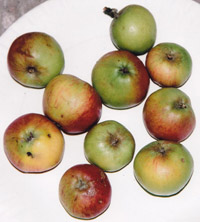
RED (HOLCROFT) Owned by John and Judy Holcroft, the tree looks
a good century old. It is an early season apple, not keeping beyond September,
medium sized, flat, round and almost all covered with deep glossy red,
over a green skin. It is crisp, sweet and with a rich flavour. The flesh
is often streaked and flushed with carmine. Very free spurring and good
for restricted forms. Pollination Group 4 |
|||
 |
BÉDAN-DES-PARTS
A Norman cider apple imported by the Woolhope Club of Hereford in 1884,
and widely used in the Herefordshire cider industry, though it also became
widely grown in Somerset. According to Hogg it became the most highly
regarded cider variety of the time because of the richness and colour
of the juice. It was raised by Monsieur M. Legrand of Yvetot and first
fruited in 1874. It is a late bittersweet with juicy, small, irregular
conical fruits. The skin is pale yellow/green, flushed red in the sun.
It was last recorded at the Apple and Pear Conference of 1934 and appeared
to have been lost in Britain. The US Department of Agriculture collection
received it from Calvados in 1937 and sent it to us in 2005. Free spurring.
Very late into blossom and leaf. Pollination Group 7 |
|||
 |
BEDFORDSHIRE
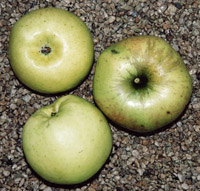
FOUNDLING A large cooker which arose around 1800, with yellow
skin, flushed orange. When first ripe it keeps its shape completely but
after a month of storage it is more willing to break down; it cooks very
quickly and has a good balance of sweetness and acidity, with enough tartness
for a good apple sauce, but sweet enough for a baked apple. It has a very
rich flavour by November. A good cropper, used from October to March.
Vigorous, free spurring, spreading trees, with large attractive blossom.
Pollination 4 |
|||
 |
BEISLY
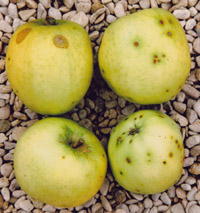
CODLING An old variety introduced to us by the owner of an old
tree, the late Marian Volins of Wallingford, Oxfordshire. It is not one
whose name can now be ascertained, so it has been renamed Beisly Codling
after her grandfather, Mr Beisly, a watchmaker whose house and shop was
in Old Wallingford town. The old properties originated from the 1600s
and back on to the site of the derelict Norman castle, destroyed by Cromwell
in the Civil War. The current house on the same site, owned by Marian
Volins, was built in the 1850s and the tree could have been planted then
or perhaps predated the building. Her family have been there for over
100 years. Her grandmother just called it ‘the Codling’ or
‘Catshead’, though it is not the Catshead of modern knowledge.
The tree is probably 100-150 years old, and has changed little for the
past 80 years. An excellent apple, ripening over a period in August and
September, though not dropping. It cooks quickly and keeps its shape,
but would reduce to a purée if wanted, needing little or no sugar,
and has a pleasant lemony flavour. It is good to eat raw after keeping,
though it does not keep for long. Some apples are still in good condition
on the tree in mid-October. A profuse bearer and a really good old fashioned
apple, with unusual mauve-pink blossom. Pollination Group 4 |
|||
 |
BELLE
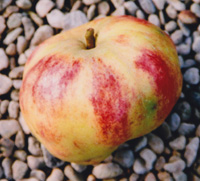
ET BONNE Though some American writers consider this an American
apple, it existed in Britain before the American colonies began and since
there is no known history of this apple in Europe, it must be assumed
to be British and probably English. Hogg, in ‘British Pomology’,
1851, says ‘In a notebook in the possession of Sir John Trevelyan,
of Nettlecombe, near Taunton, which was kept by one of his ancestors,
from the year 1580 to 1584, is an entry of “The names of Apelles,
which I had there graffes from Brentmarch, from one Mr Pace”’.
This includes ‘Bellabone’. John Parkinson in 1629 said ‘The
Belle boon of two ?orts winter and ?ummer, both of them good apples, and
fair fruit to look on, being yellow and of a meane bigne??e.’ While
the summer one seems to have been lost, and there might be another apple
to consider - a different Belle Bonne – in the old literature, the
winter Belle et Bonne has survived in America, though it has passed out
of knowledge in Britain. John Evelyn had Belle-et-Bonne in his Kalendarium
Hortense of 1669, but he tended to use names a bit randomly. For use in
September he has Belle-Bonne, in October he has Belle-Et-Bonne and in
November he has Belle-Bonne. Thomas Langford of Dunstable, Bedfordshire,
in ‘Plain and Full Instructions to Raise All Sorts of Fruit Trees’
in 1696, listed Belle et Bonne. John Worlidge in his Vinetum Britannicum
of 1678 says ‘The Summer Belle and Bon, is a fair Apple, and the
Tree a good bearer; but the Fruit is not long-lasting; for a short time
it’s a good Table-fruit, and makes indifferent good Cider. The Winter
Belle and Bon is much to be preferred to the Summer in every respect.’
He seems to echo Parkinson’s description of Belle Boon. Philip Miller
in 1724, in ‘The Gardeners and Florists Dictionary’, in the
first edition, includes ‘A Catalogue of Curious Fruits’ which
has Belly Bon. Lindley (1831), Scott (1872) and Hogg (1884) also described
Belle Bonne similarly. There have been no sightings of it in England since
this time. Through all the confusion of the past and sometimes careless
literature, there pervades a strong sense that Belle Bonne and Belle et
Bonne are the same and a very old English apple, named at a time when
French was still widely spoken here. Having been sent scions by the late
Nick Botner at the end of the 1990s, we have had time to evaluate this
excellent apple. It is ripe at the end of September, is green turning
yellow and has red streaks and blushes in the sun, often running down
the lines of the ribs on the body. This accords with Lindley’s description.
At other times the apples can be just yellow with prominent pale spots,
according with Scott’s description. The flesh is crisp, juicy, sweet
and really rich, with just the right amount of acid. In a good year it
is near perfect. It can be cooked, though it is a bit resistant to softening,
unless stored, and it retains its very rich, sweet flavour, becoming a
little more tangy and fruity. It will store into the new year. An exceptional
apple. Pollination Group 4 |
|||
|
||||