


| |
|||||
|
|
|
|
|
|
|
|
|
 |
 |
 |
|
||||||||
 |
||||||||||||
 |
|
|||||||||||
|
||||||||||||
 |
|
|||||||||||
|
||||||||||||
 |
|
|||||||||||
|
||||||||||||
 |
|
|||||||||||
|
||||||||||||
|
|
 |
 |
|
|||
 |
||||||
|
|
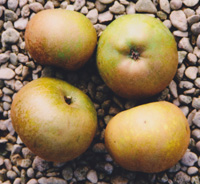 |
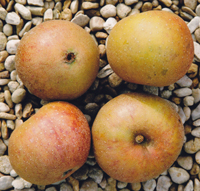
POMME GRISE Forsyth tells us, in 1810, that “Pomme Grise, was introduced into this country by Mr. Alexander Barclay, of Brompton, well known for his ingenuity in bleaching of wax. He is a great lover of horticulture, and has raised several new sorts of Gooseberries from seed. This is a fine Apple, from Canada, of a flattish form and russet colour, streaked beautifully with red. It ripens late, and keeps till March. This is an excellent eating Apple.” Bunyard (1920) said that it came to England from Canada in 1794. Downing (1878) thought that it might originally have been French or Swiss, but there are no records in those countries to support it. Hedrich, in America in 1922 said that it had been cultivated more than a century in Canada and “finds greatest favor among the French in the valley of the St. Lawrence”. It might well be French and very old indeed, having been planted along the colonization routes of the French in Canada in the 17th or 18th century. Throughout the 19th century it was known and appreciated for the rich little apple that it is, but it has been unknown here, after Bunyard wrote of it in 1920. It has lived on in America, throughout, and is also now in the Belgian national collection, but not encountered elsewhere. Hogg in 1884 described it as a dessert apple, small, roundish/ovate, with skin covered in rough russet. Underneath the russet it is green in the shade, but orange in the sun. The flesh is tinted yellow, crisp, very juicy and sugary, with a brisk and highly aromatic flavour. The eye is small and open, set in a narrow and shallow basin. The stalk is about half an inch long, inserted in a shallow and small cavity. This is the apple that is known in America and our experience of it, having been sent scions from the collection of the late Nick Botner, in Oregon, in 2001. Apples here are ripe in early October, when they are gently crisp and crunchy, very sweet, richly flavoured with just the right amount of acid and bursting with juice. The skin is covered with broken russet, and it can be a little tough, but not enough to deter the pleasure inside. The apples store over the winter. Pollination Group 4 |
||
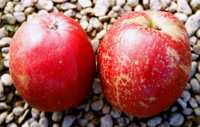 |
POPE’S SCARLET COSTARD Bunyard, in his Handbook of Fruits, 1920, said the history was unrecorded and nothing more seems to have come to light since. He also said it was ‘not worthy of cultivation’, but we cannot agree. He described a dual purpose apple keeping till March (we find it not ripe until November) medium sized, conical, fairly regular, pale yellow almost covered with dark brownish crimson (we say almost mahogany and often more streaked than ‘almost covered’). The flesh is crisp, juicy and greenish (we find it cream), pleasantly flavoured. The eye is closed in a shallow, ribbed basin, much knobbed at the top. The stem is short in a very small russet cavity. We find it a perfectly pleasant, crisp, juicy, sweet and well flavoured eating apple, which, when cooked, keeps its shape, becomes yellowish and is sweet and rich. All of the apples claiming to be ‘Red Costards’ can be traced back to the same source and have been found to be, after dna tests, the same as this apple. It remains a remote possibility, given the lack of any history, that this apple might have a claim to be one of the old Costards. Pollination Group 5 |
|||
 |
PORT
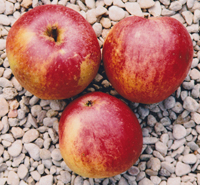
WINE KERNEL Also called Port Wine Pippin. The old tree was found
at Hay Redding Orchard at Chaxhill, Gloucestershire, and propagated before
entering the collection of the Gloucestershire Orchard Group, who provided
scions for us. A medium sized, dessert and possibly cider apple. Conical,
with green skin turning warm yellow, flushed and streaked with red, sometimes
covering most of the apple and sometimes quite dark red. The nature of
the apples varies quite a lot from year to year. In late September the
apples are very juicy, very sweet and with a good, rich flavour, with
hints of banana and an additional floral savour. The flesh is not crisp,
but not soft either. It is best called tender. In some years an excellent
dessert apple. Pollination Group 5 |
|||
PORTER
An old American apple, long grown in Britain. Calhoun, in ‘Old Southern
Apples’ (1995) writes that it was first grown around 1800 by the
Rev. Samuel Porter of Sherburne, Massachusetts and that it was atypical
for such ‘northern’ apples to retain their fine qualities
when grown in the warmer ‘south’. It was a popular commercial
fruit in the USA in the middle of the 19th century. He adds that, when
cooked, it keeps its shape and retains flavour well, though it is also
a dessert apple. Small and large apples ripen together over a two month
period. Scott, in 1872, claims to have brought it from America and introduced
it through his nursery. He describes it as a small to medium, top quality,
September to October fruit; oblong, regular and narrowing towards the
eye. The skin is glossy, bright yellow and with a deeper tinge in the
sun or a light blush. The flesh is ‘fine grained, and abounding
in juice, sprightly, agreeably aromatic, and nicely subacid’. He
adds the tree is a free grower and fruits abundantly, ‘and deserves
extensive cultivation’. Pollination Group 6 |
||||
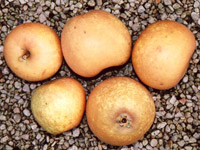 |
POWELL'S
RUSSET A once popular old Somerset apple dating from before 1700,
now rare. Taylor reports in "The Apples of England", 1936, that
Powell's Russet was a medium sized Somerset dessert apple with green skin
and much russet marking. The apples were said to be round and flattened,
the eyes open in a shallow saucer and the stems of medium length in a
russeted cavity. This description accords with the tree we have, acquired
from Mr and Mrs Tann of Aldham, Essex. Apples are a little hard when young,
but soften and develop a full rich flavour, later. Pollination Group 4
|
|||
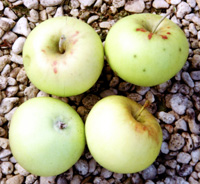 |
PRESCOTT’S
PIPPIN Grown as a seedling during the 1930’s by Emily Prescott
at Stoke Fleming in South Devon, and reported to us by her son, John Dietz,
also at Stoke Fleming, Dartmouth, Devon, who was keen to preserve it,
as it cropped so well and in an area which was difficult for apples. We
grafted new trees for him and also kept one here. The apples are large,
up to 4 inches wide but flattish, obscurely ribbed and more so at the
eye, green becoming yellow and with a slight orange flush when ripe in
full sun. Apples are ripe in early September and do not store for long.
They cook to a purée. They can also be good to eat raw and are
sweet enough for most. Pollination Group 5 |
|||
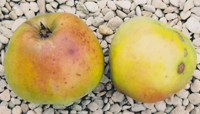 |
PRESTWOOD
GOLD While exploring old trees in Prestwood, Buckinghamshire,
once famous for its extensive cherry orchards, with our local guide, George
Lewis, we visited a very old tree in the garden of Lesley Stoner. Mr and
Mrs Stoner’s house was built in the 1850s on the edge of the common,
in an area of old cherries interspersed with apples, part of which became
the garden. The tree seems to be of an age before 1850. Named by Lesley,
this large, mid season cooking apple is green becoming golden, with sometimes
a warm blush, and breaks down to a very sweet and rich purée. In
some years, the fruit can be a very good eating apple, crisp, sweet, rich
and tangy. It does not keep beyond the autumn. A very good apple. Pollination
Group 4 |
|||
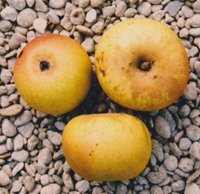 |
PRIMROSE
PIPPIN An interesting early to mid season apple notified to us
by Helen Beale who sent cuttings from a tree owned by Ted and Iris Watts,
who later kindly sent us fruit. Their property at Flexford Farm, Lymington,
Hampshire was formerly owned by Tess Longman who died in her 80s. Tess
used to provide Helen with apples. They were known as Primrose Pippins
by Tess Longman. There were once five trees of it and two remain. The
unusual numbers suggest it was once a commercial orchard. The small rounded
and flat yellow apples, with some russet, are ripe in late August to September
and do not keep long, but have a fine, rich flavour. Pollination Group
5 |
|||
 |
PRINCE
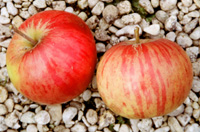
ALBERT In 2019, David and Lindsey Slingsby of Bosbury, near Ledbury,
Herefordshire, told us of a tree that was known from an early age by their
Uncle Joe (Joe Box). He was 93 in 2022 and still going strong. He had
lived all his life by an old orchard - the remnants of an old jam fruit
orchard. He had always known this tree as Prince Albert. The tree was
very old when David sent us scion wood and age and the drought of 2022
have since ended its life. Uncle Joe thinks his uncle planted it. It was
a small tree when Joe was a young man. David and Lindsey grafted a new
one for their home and they sent scions to us in 2020. They report it
is very good for cooking and juicing. Two different Prince Alberts have
been noted in old literature. In 1872, it was noted in Scott’s ‘The
Orchardist’. He said only that he obtained it from France and that
it had not yet fruited with him. The name also appeared in the Rivers’
Nursery catalogue in 1862 and 1863, noting one parent as being Golden
Harvey, and describing a small, very rich apple. This cannot be the same
as Uncle Joe’s. Hogg, in the 1884 ‘The Fruit Manual’
merely made the name a synonym of Lane’s Prince Albert and Smart’s
Prince Arthur, but Uncle Joe’s apple is neither of these as shown
by these apples dna profiles. Curiously, there was a match with an apple
in the National Collection – ‘NFC Unknown 1945-134’.
Possibly, there existed a variety called Prince Albert before nurseryman
Lane introduced another apple, in 1857, which he was obliged to distinguish
from the former by adding the name Lane’s. Pollination Group 4 |
|||
 |
PRINZENAPFEL
A German dessert apple known in the 18th century, and first recorded in
England in the London Horticultural Society catalogue of 1826. The L.H.S.
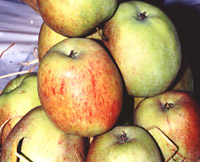
catalogue of 1842 described it as medium sized, oblong, pale yellow, flushed
red and ripe in October. An attractive apple, long and gently ribbed with
golden skin mostly covered with an orange red flush and carmine streaks.
The flesh is fine and tender, rather than crisp, moist enough and very
rich. The acidity is just right. After keeping a week or two, by the end
of October it has a rich strawberry flavour, but is, by then, softening.
There are sometimes red blotches in the flesh. The appearance is both
unusual and attractive, and the apple is still popular in Germany and
elsewhere in northern Europe. Pollination Group 4 |
|||
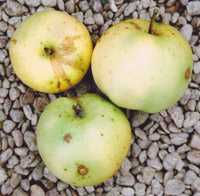 |
PROFIT 1 Also called Profit Apple, it was once a widespread and popular culinary apple, first recorded in 1863. The National Apple Register records that it was still in existence in 1947, but no examples were found in recent times until two visitors to an apple day in 2001, at Kingston Maurward College, Dorchester, brought in some anonymous apples. They were identified as being the ‘lost’ Profit Apple. One was from George Tozer of Woodcutts, near Salisbury, the other was Barry Wenham, of the Manor House, Fordingbridge, Hampshire. Neither of their names and contact details were kept at the time, but a television appeal managed to locate them. Chris Hunter of Kingston Maurward College sent us scions of both trees shortly after. However, they are different and neither seems to match the fairly brief historical descriptions of Profit. This one is a late season, medium sized eating apple, green turning pale yellow, roundish and lightly ribbed, with crisp, juicy, rich flesh in early October and keeps well into November. If either Profit 1 or Profit 2 is the ‘lost’ Profit’ it is more likley to be Profit 2. The Pollination Group is 5 |
|||
 |
PROFIT
2 As with Profit 1, an apple brought to the 2001 Apple Day at
Kingston Maurward College, Dorchester, when two different visitors brought
in anonymous apples which were identified as being the ‘lost’
Profit Apple. The scions we received from the Apple Day organizers were
from both sources but were not labelled as to which source. Profit 2 is
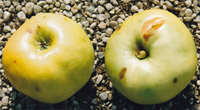
a larger apple than Profit 1 and is more flat than round, with smoother
skin, becoming clear yellow sometimes with a warm blush. The skin is tough
and, after picking, the apples go a little greasy – both hallmarks
of an apple that will store well. They can be eaten raw, and the flavour
is sweet and mild, but a little weak. The cooked fruit keeps its shape,
has a rich perfumed flavour and has no need for added sugar. It gives
up hardly any juice and is ideal for mincemeat, chutneys and open tarts.
Ripe in October, the apples store beyond December. If either Profit 1
or Profit 2 is the ‘lost’ Profit’ it is more likley
to be Profit 2. Pollination Group 5 |
|||
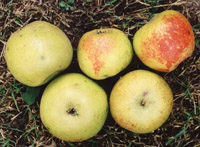 |
PUCKRUPP PIPPIN A late dessert apple, first described in 1872, though possibly a much older apple. The accession in the National Collection is believed to be different to that described in 1872, and has been renamed Puckrupt Pippin. Ours is from the Tann collection. It may have originated in Puckrup, Gloucestershire. An apple with a sweet, citric flavour and firm, deep cream flesh, storing until February. Pollination Group 4 | |||
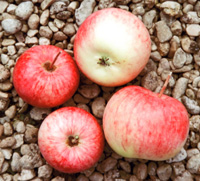 |
PULLEN’S
EGG In Old Headington, now part of Oxford, is Pullen’s
Lane, named after the Rev. Josiah Pullen, famed for his Wych Elm that
was planted by him in 1700 and destroyed (deliberately) by fire in 1909.
The site of this tree was at the entrance to what is now the `St Clement’s
& District’ allotments, where this apple tree now grows. He
seems to have owned Pullen’s Farm and the lane might have been named
from that. This upper part of Headington, already home to many fruit trees,
was a major 650+ acre estate for Headington Manor. passed into the ownership
of Mr G.H. Morel, whose family escaped from France in the 1780s. His descendants
later became the famed Morrell’s Brewery dynasty. Later still it
was owned by Robert Maxwell and Pergamon Press. The allotments were laid
out 1919-20 and leased to Oxford City Council. In recent years, part of
their land was purchased by Oxford Brookes University for new buildings,
and the tree of Pullen’s Egg is now on their land, though still
used as allotment. It has a Tree Preservation Order on it now. This is
a large tree and an old one, with the size and girth suggesting it was
there well before the allotments were created. It produces apples a bit
out of the ordinary. It has two trunks from low down, suggesting that
ground level has been made up after the tree was planted. Overshadowed
on one side by a mature oak tree, it has now become one sided and semi-weeping.
The bark is rather unusual. The dna is unmatched and after local consultation,
Phil Baker, resident of Headington, who told us about this special tree
and who has provided a lot of history on the area, has decided to call
it Pullen’s Egg, the word ‘Egg’ coming from the nickname
of Emily, a family member, and from a weak pun on Pullets, whose eggs
were small. Ripe in late August to mid September, the apples are small,
flattened and very prettily streaked in pale strawberry to crimson, over
a base colour of almost white. The flesh is sweet, juicy and richly flavoured,
though apples are best eaten within a few days of picking. Pollination
Group 4 |
|||
|
||||