


| |
|||||
|
|
|
|
|
|
|
|
|
 |
 |
 |
|
||||||||
 |
||||||||||||
 |
|
|||||||||||
|
||||||||||||
 |
|
|||||||||||
|
||||||||||||
 |
|
|||||||||||
|
||||||||||||
 |
|
|||||||||||
|
||||||||||||
|
|
 |
 |
|
|||
 |
||||||
|
|
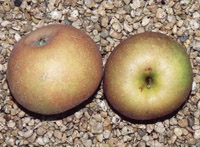 |
ASHMEAD’S KERNEL A late dessert apple raised around 1700 by Dr. Ashmead of Gloucester, but which did not become widely planted and popular until the middle of the nineteenth century. It was very much appreciated by Victorians and Edwardians because of its complex flavour, which is both sweet and sharp, and for its firm white flesh. Sweetness develops with storage. In the first half of the 20th century it fell into obscurity, but has enjoyed thorough appreciation since. The trees have attractive blossom and the fruit stores until February. Cropping can be irregular. T* Pollination Group 4 |
||
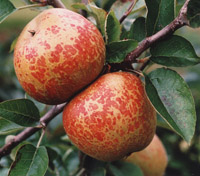 |
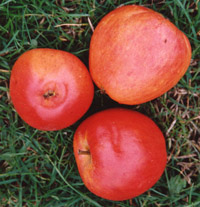
AUTUMN PEARMAIN Also called the Summer Pearmain, though there is some confusion between the two in the old literature and there is much evidence to suggest that other Summer Pearmains noted were quite different. This apple is probably not the true Summer Pearmain. Autumn Pearmain was the preferred name of Lindley and, later, Hogg, and has endured. See Summer Pearmain later. Autumn Pearmain is an attractive mid season apple, with a red flush and fine russeting. The flesh is firm, with a pleasant, sweet taste. It has been described as tip bearing, but is very willing to form spurs. Pollination Group 4 |
|||
 |
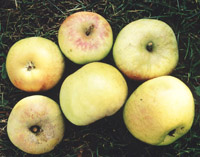
BAKER’S
DELICIOUS A Welsh dessert apple of uncertain date, but introduced
by Baker's Nursery of Codsall, Wolverhampton, in 1932. Pale golden fruit,
sometimes lightly russeted, blushed and often fully streaked with orange/red
and with richly flavoured, juicy cream flesh. Fruit is ready in early
September and will store for a few weeks. Pollination Group 4 |
|||
 |
BALL’S
PIPPIN - Was introduced by Allgrove's Nursery of Middle Green,
Langley, Buckinghamshire in 1920. It was said to be a cross between Cox's
Orange Pippin and Sturmer Pippin. A medium sized, roundish dessert apple
with a flattened top, ribbed at the eye. The skin is green-yellow, with
a red flush, netted with russet which often breaks the red flush. The
flesh is white, sweet, fragrant, crisp and juicy, when ripe in October.
It stays crisp and juicy to the year end and will last to March. It received
an Award of Merit from the RHS in 1923. Scionwood was given to us by Geoff
Goodchild, from his old tree at Hughenden Valley, Buckinghamshire. Pollination
Group 4 |
|||
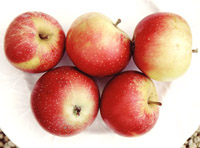 |
BAMFAIRS
An old Oxfordshire variety, also called Bampton Fairing, but we adopt
the name by which the last known old tree has been called by the owners,
Mr and Mrs Harris of Lovegrove’s Farm, Fordwells. The family of
Mrs Olive Harris have lived there since 1836; her great grandfather, who
had the tree, died in 1915, and the tree is now well over 100 years old,
modest in size but healthy and a good bearer. It takes its name from the
old tradition of it being ripe on the day of Bampton Fair, where it was
sold. Ripe in early September, the medium sized apples are deep red over
pale green, with numerous starry dots. It is crisp, juicy, sweet and tangy.
The apples will store for a few weeks. Mr and Mrs Harris are also the
owners of the only old tree of Annual Sweetening. Pollination Group 4 |
|||
 |
BARNACK
BEAUTY Raised by a cottager in 1840 at Barnack village, Northants,
near Stamford, but not introduced until 1870 by Browns of Stamford. A
late dessert apple with unusual oval fruit, flushed deep red, juicy, crunchy
and with an intense flavour. It may also be used for cooking. Strong growing,
spreading trees, with decorative blossom. Fruit stores until March. It
has been said to be one of the best varieties for chalk soil, though it
is always the rootstock that has to contend with particular soils. Pollination
Group 4 |
|||
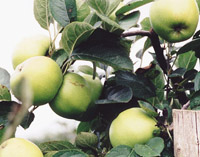 |
BASCOMBE
MYSTERY An old English apple whose origin is unknown. It was
in the collection of the London Horticultural Society in 1831. A good
dessert apple, also with a history of culinary use. The medium sized apples
are obscurely ribbed on the sides, with skin of uniform grassy green,
sometimes flecked white, turning more yellowish as it ripens. The flesh
is crisp, juicy and perfumed. It is ripe in November/December, but can
improve with storing. Pollination Group 7 |
|||
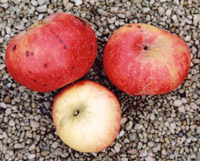 |
BAUMANN'S
REINETTE Raised by Baumann in Alsace, or possibly by Van Mons
in Belgium, and first recorded in 1811. It has been long grown in Britain
and was in the London Horticultural Society collection, at Chiswick, by
1842. A very good, handsome, dessert apple, boldly striped with crimson,
merging to a full blush, with crisp, juicy, sweet flesh, faintly flavoured
of strawberries. Ripe in September, it crops regularly and stores well
until Christmas. It can also be used for cooking, keeping its shape. Pollination
Group 3 |
|||
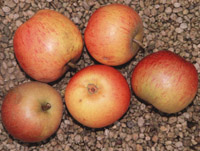 |
BAXTER’S
PEARMAIN A vigorous tree which was grown in Norfolk as early
as 1821. Greenish yellow fruit, with orange tinges, red streaks and occasional
russeting. The crisp fruit is dual purpose, with white, juicy, tangy flesh,
richly flavoured, and which keeps its shape when cooked. A heavy and regular
cropper. The fruit stores well, to January or February. Pollination Group
5 |
|||
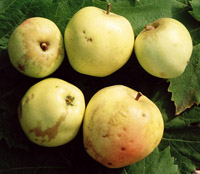 |
BAZELEY
A rare old Buckinghamshire variety originating at, and once found only
around ‘The Lee’ near Great Missenden. It has also been called
Baseley, Baysley or Bezeley, the origin being that it was deemed the 'Best
of the Lee'. At one time, most of the farms and cottages had a Bazeley.
It was brought to notice by the late Susan Cowdy (of the Liberty family,
owners of the London store), who was renowned locally in the Chilterns,
at the Lee. She said the apple was much used in olden days for mincemeat
and mince pies, due to its sharpness and suitable texture, staying intact
when cooked. We first learnt of it from a former employee and friend,
Sylvia Firnberg, who brought scion wood to us from the tree of the actor,
the late Geoffrey Palmer, of Hunt's Green. Our thanks to all concerned.
The apple is a medium sized, round and conical, green cooker, turning
yellow, that in most years also attains top quality as an eater, even
when first ripe. It sweetens with storage. Crisp, sweet, acid and richly
flavoured, it keeps its shape, sweetness and acidity when cooked. Pick
in October and store until January. The fruit ripens over a period. It
freely bears spurs and fruits prolifically, to the extent that it might
need thinning. When cut, the flesh does not discolour. Pollination Group
5 |
|||
|
||||