


| |
|||||
|
|
|
|
|
|
|
|
|
 |
 |
 |
|
||||||||
 |
||||||||||||
 |
|
|||||||||||
|
||||||||||||
 |
|
|||||||||||
|
||||||||||||
 |
|
|||||||||||
|
||||||||||||
 |
|
|||||||||||
|
||||||||||||
|
|
 |
|
||||
 |
||||||
|
|
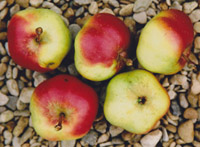 |
API ÉTOILÉ Known in France in the early 1600s and in Britain by 1772 when Richard Weston of London said, in “The Universal Botanist and Nurseryman” under the names of Long-Stalked Star-Apple and Pomme D’Etoile à longue queue, that it was “Shaped like the Api, but with very little red.” It was in the first collection catalogue of the London Horticultural Society in 1826, which called it just Etoilée. Hogg described it as a variety of Api, but with a very distinctive shape; the apples are unusually flat and with five prominent ribs, giving it a star (Etoilé in French) shape in cross section. Deep yellow skin in the shade, but orange-red near the sun. He said it had a good flavour for dessert, but not first rate. Ripe from the end of September. This is not our experience. It must be left alone on the tree into the early winter, when the full flavour emerges. It remains hard until stored, when it is very rich, though a shade dry in February. Markedly ribbed, flattened, and usually small in size. Both Scott, in 1872, and Barron in 1883 (when it was exhibited from Barham Court, Maidstone, Kent) described it as a small and pretty apple. It has not been noted in Britain since the 19th century, but has continued to be grown in Europe. We received it from the French National Collection. It is a regular bearer here. A very pretty and tasty apple which has starry, pale blossom. Pollination Group 3 |
||
|
||||
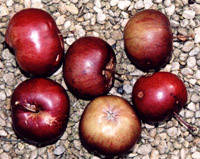 |
API
NOIR Probably
of French origin, and first mentioned by Olivier de Serre in 1608, as
Calveau Noir. It was known in the London Horticultural Society’s
collection at the time of the 1826 catalogue. The small, sweet apples
have a very deep red to maroon flush and stay crisp until spring. Their
striking colour made them popular for garlands and table decorations.
Trees were often a decorative feature in gardens, where they were grown
in pots on dwarfing paradise stocks, as low edges to beds and as cordons.
They were valued for their pretty blossom and for the brilliant display
of fruit, which is generously produced and hangs on the tree well into
the autumn. They keep until April. Hogg called it larger and flatter than
Api with tender skin, smooth and shining, of light yellow or black, strewed
with fawn dots and some russet. The eye is very small in a deep, plaited
basin. The slender stalk is three quarters of an inch long in a deep,
wide funnel-shaped cavity with light russet. The flesh is pure white,
firm, juicy and tinged red below the skin, with a pleasant, vinous, and
perfumed flavour. A good dessert apple that will last to April but can
get mealy, by then. The rich flavour endures to the end of the year but
fades a little in January. Pollination Group 4 |
|||
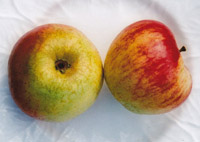 |
APPLEFORD
SERENDIPITY An important old apple tree, introduced to us by
Pamela Brice and her daughter, Clare, of Appleford Farm, Rivenhall End,
Essex, who are justly very proud of their tree. Aside from being a good
old dual purpose apple, now without its original name, which will not
be readily discoverable, it is important for the way in which the old
hollow trunk is regenerating itself. It is discussed in detail on our
website, in an article on old trees and the ways they survive. The tree
is the last survivor of a domestic farm orchard and was old when Pamela
Brice went to live there 59 years ago. The farm had been in the family
for 400 years. Now hollow and a ‘squirrel run’, it still produces
well and is now advanced in producing new trunks from the old one. The
name was given to it by Pamela and Clare. The medium sized, sometimes
large, conical dessert apples are beautifully streaked with red, ripe
in October and sometimes later, in November. The flesh is pale, fine,
crisp, juicy, sweet and with lively, lemony acid. When cooked, it is slow
to soften and gives up no juice, and remains firm, keeping all its shape.
It then develops a much sweeter, richer, fruity flavour, not too sharp
and with no need for added sugar. In December the fruit goes a little
cidery in flavour. We are grateful for all the help and enthusiasm of
the Brice family. Pollination Group 5 |
|||
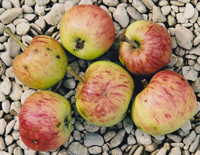 |
ARCHIDUCHESSE
SOPHIE Around 1823, an apple was raised by Joseph Schmidberger
at the monastery of Saint-Florian near Linz, Austria. It was named Erzherzogin
Sophie, though it was subsequently known in France and England under the
name of Archiduchesse Sophie, or Archduchesse Sophia. In 1872, famed nurseryman
John Scott described it thus: “Small, top quality, January to February.
A fine and beautiful sort for the dessert; well worth cultivating for
its fine appearance.” It was still known up to 1895, but had disappeared
from all collections around the world and appeared lost. When we compiled
our database of lost apples and possible sources we noted the Archiduchesse
in the Grove Collection in Tasmania and they sent us scions in 2005. It
first fruited in 2013 and is surely the same apple. Usually a dainty apple,
it can sometimes be large. Pale yellow skin, speckled, streaked and striped
with pink and carmine. Round and slightly flat, sometimes with rounded
ribs. The tender flesh is richly flavoured, fragrant and sweet, with just
the right amount of acid. Sometimes there is a hint of aniseed. In our
warmer summers, it is ripe in early October, and will keep until the year
end. Pollination Group 5 |
|||
 |
ARD
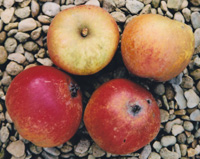
CAIRN RUSSET Discovered by Baylor Hartland in a garden in 1890
and introduced by Hartlands of Ard Cairn, County Cork. A medium sized
fruit with yellow skin, often with a bright orange-red flush or stripes,
and mostly or totally covered with warm russet. The shape is truncate
conic, ribbed around the deeply set eye and with obscure ribbing. The
flesh is firm, slightly dry, and with a very rich flavour which becomes
even more intense after storage. It can be very sweet indeed. Sometimes
it is ripe in late September, though usually later, and it will keep until
December. Bunyard says best in January to February and that it is 'perhaps
one of the best russets for dessert', but warmer winters do not allow
it to last into the New Year. After November it remains very sweet, but
the flavour is lost and the flesh is shrinking. It has an upright growth
habit. Pollination Group 4 |
|||
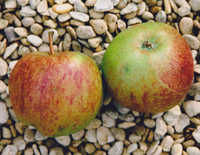 |
ARLINGHAM
SCHOOLBOYS – An old variety named before 1914, taking its
name from Arlingham, Gloucestershire, and made known by the Gloucestershire
Orchard Group. A dual purpose apple and a vigorous tree. When cooked it
keeps its shape, with a mild flavour, but it is, perhaps, better as a
dessert apple. The apples are medium sized, often tall and oblong with
skin of green, with fine red streaks and a red blush on the sunny side.
It is quite late to ripen here, at the end of October, when the sharpness
fades to leave a sweet, rich, crisp and juicy apple. The fruit will store
into the New Year. Large flowers with dark buds. Pollination Group 4 |
|||
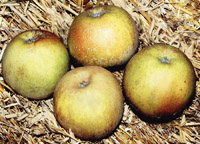 |
AROMATIC
RUSSET A spicy, richly flavoured dessert apple, long known in
England and once very popular. It was listed in the Aldby Park archive,
discovered by Louise Wickham and sent to us, believed to have been written
in the middle, possibly the first half, of the 18th century, from known
plant dates and the script style. It could be the planting list of Thomas
Knowlton, who worked between 1725 and 1760 on various estates in Yorkshire,
including Aldby Park. It was listed in the London Horticultural Society
catalogues of 1826 to 1842. Medium sized fruit, greenish-yellow in colour,
covered with silvery-brown russet and tinted tawny orange on the side
near the sun. Small trees, which bear good crops. The fruit is ripe in
October and will store until February. Pollination Group 3 |
|||
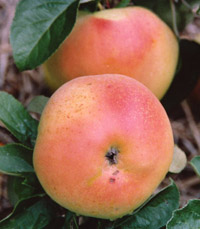 |
ARTHUR
TURNER Introduced in 1912 by Charles Turner, of Slough, as Turner’s
Prolific. An early cooking apple, ripe in September, which can be used
for most culinary purposes and needs little sugar. It was once popular
with commercial growers as it is an abundant cropper and is not prone
to scab. Good for espaliers and cordons as it freely bears spurs. Primarily
a good baking apple. Pollination Group 3 |
|||
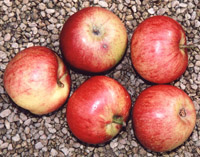 |
ARTHUR
W. BARNES A medium to large dessert/cooking apple raised by N.F.
Barnes, head gardener to the Duke of Westminster, in 1902. It was introduced
by Clibran's of Cheshire in 1928. A cross between Gascoyne's Scarlet and
Cox’s Orange Pippin, it has attractively red streaked apples and
was once a popular exhibition fruit. It cooks to a juicy, pale yellow
purée, after storing for a while, though it keeps its shape when
first ripe. When fully ripe is a crisp, sweet and juicy dessert apple.
Middle to late season, storing until December. Pollination Group 4 |
|||
|
||||