


| |
|||||
|
|
|
|
|
|
|
|
|
 |
 |
 |
|
||||||||
 |
||||||||||||
 |
|
|||||||||||
|
||||||||||||
 |
|
|||||||||||
|
||||||||||||
 |
|
|||||||||||
|
||||||||||||
 |
|
|||||||||||
|
||||||||||||
|
|
 |
 |
|
|||
 |
||||||
|
|
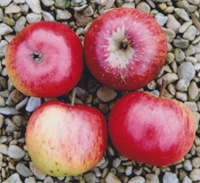 |
GLOSSY OTTER The Polecat Public House, at Prestwood, Buckinghamshire, contained several old and interesting apples in its extensive orchard garden, and we took scions of all, with the permission of the former owner, John Gamble, in 2005. Unfortunately the new owners have removed most of the trees to enlarge the car park.The fruits bore all the hallmarks of varieties planted to provide both food and cider for the old Inn’s guests. The trees were at least a century old and many very old. We have named them after the Mustelid family of creatures, such as weasels, stoats and otters! This apple is medium sized, rounded and uniform, with yellow skin almost all covered with a crimson blush and streaks. The skin is very glossy. The fruit is ripe in early November, sweet, crisp and juicy with a rich flavour. The apples will store to the year end. Pollination Group 3 |
||
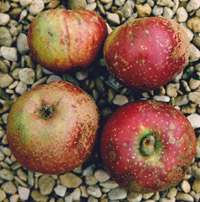 |
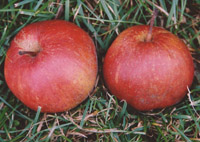
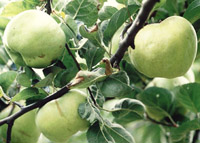
GLOUCESTER ROYAL Raised around 1930 at Dursley. Probably best as a cider sweet, but can be eaten without distress and without exhuberance. A small to medium fruit, with green and orange skin, flecked and blushed with fine red. Ripe in October, the flesh is sweetish, lacking much acid, a bit dry and a little chewy. Late season, storing to November. Dark buds. Pollination Group 5 |
|||
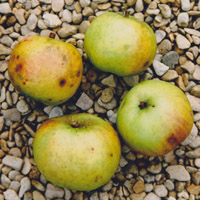 |
GLOUCESTER
UNDERLEAF A variety known since 1883. Small to medium-sized fruit
with a yellow skin, blushed amber-red in the sun. It has been said to
be triple purpose but, as a dessert apple it can be a bit dry and woolly,
and a bit short on sweetness, with a modest flavour. Cooking it does not
improve it much. Best for cider. Mid season, storing to November. Pollination
Group 5 |
|||
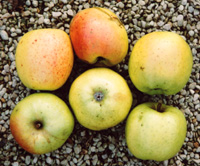 |
GODFREY
GRAND A lovely old apple, not matched with the DNA of others
known. Beryl Godfrey and her late husband, Ray, showed us the tree early
in the new millennium, at Meadow Lane, Iffley Village, their house being
built in an old orchard, at the edge of the water meadows that nestle
against the River Isis (Thames). There are other old apples in the immediate
area, such as the Iffley Beefing and Iffley Codlin just a short distance
away, all these trees seeming older than the houses they now own. This
particular old tree was split on the side and decaying, the higher part
being hollow. The trunk is interestingly ribbed as though sap routes are
rounding off to become new trunks in future. There is also a visible ring
at about 5 feet, where it might have been grafted or constricted in the
past. The apples are very good. The medium to large apples are a shapely
oval form and yellow with pink dots or sometimes a warm blush. Medium
to large, the flesh is very tender, but crisp and not soft, pale and very
sweet with a good acid balance and fine flavour. An excellent eating apple
which also cooks moderately quickly to a very rich, sweet flavour keeping
its shape but softening. Excellent for pies and tarts. Ripe in early October,
the apples will keep well to the year end. A reliable cropper. Pollination
Group 4 |
|||
GODWICK
APPLE Jamie Randall, on a walk along the ancient deserted village
of Godwick, Norfolk, noticed a very old apple tree and an equally ancient
walnut tree. Knowing of our interest in old trees, he talked to us about
it in 2019, and sent wood for grafting that winter. These trees are completely
out of time and place, since the village had gone by the end of the 16th
century. Since then this poor and wet clay land has only been used for
animal pastures. Any seedlings would surely have been grazed out by livestock
and we are left with the conclusion that these two trees have survived
from the 16th century. The village barely reached any size as the land
was so uncompromising and by 1590 only a few houses were left, and would
have been cleared to make way for a Hall and parkland started in 1586,
and a Great Barn in 1597. There can have been no reason to plant them
since. Godwick was an Anglo-Saxon village, near Fakenham in Norfolk. By
the late 16th century only two tenant farmers occupied the land. If not
planted in a villager’s ‘close’, it is possible this
apple tree was planted in the orchard of the church, the last relic of
which, the Tower, was turned into a folly in the 1580s. It seems unlikely
that it was part of the Hall’s orchard, as the tree seems very remote
from this (and the Great Barn). The Hall was abandoned in the 1830s after
a fire and pulled down in the 20th century. Our tree has not yet fruited
so we cannot describe it properly yet. We include the apple here for the
enthusiast for ancient trees. Pollination Group 4 |
||||
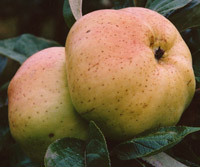 |
GOLD
MEDAL The original name was Ryland Surprise and it was new in
1882, raised by Mr Troughton of Preston, Lancashire. It is for both dessert
and culinary use, early to middle season (August-September), large in
size and with pale golden skin, sometimes becoming amber. It was very
popular in its native Lancashire and the Isle of Man, but also in the
London area. The flesh is yielding and slightly acid, but juicy, crisp
and sweet and with a fine flavour when first ripe. The trees have compact,
dense growth. It will store until November, but by then it is starting
to soften, the flavour is becoming cidery and the sweetness is fading.
Pollination Group 3 |
|||
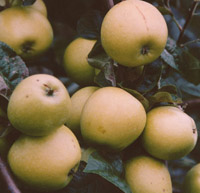 |
GOLDEN
BITTERSWEET An old Devonshire cider ‘bittersweet’
that was first recorded by Hogg in 1884. The accession in the National
Fruit Trials did not accord with the early descriptions and the true variety
was re-discovered in modern times by the former Thornhayes Nursery in
Devon. The Herefordshire Pomona described it as – ‘a Devonshire
apple, large and conical with ribbed sides. It is a yellow apple, with
a red cheek, and sprinkled over with small russet dots and traces of russet.
The tree bears freely and the fruit keeps well. It has a good repute as
a cider apple’. Hogg says it was sent to him by Mr Rendall of Netherton
Manor. The flesh is dry, woolly and slightly sweet. It bears well and
‘keeps without wasting’. Late season. Pollination Group 5
|
|||
 |
GOLDEN
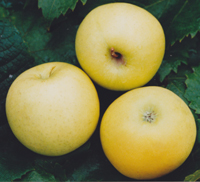
DELICIOUS An excellent apple, but one which has acquired a damning
reputation in England, based upon the wide experience of the rubbish that
was imported here from France, from the 1960s onwards. It was once extensively
used in baby food, when the poor infants were not able to vocalise complaint.
Grown in our climate and left to mature properly, it is a very crisp,
juicy, sweet and rich apple of complex flavour. It originated around 1890
with the father of Anderson. H. Mullins of Clay County, West Virginia
who bought some Golden Reinette trees which are believed to have pollinated
his Grimes Golden and a chance tree established itself in a fence line.
His son sold it to Stark Brothers who named it and introduced it in 1914.
It came to England in 1926, when acquired by Edward Bunyard at Bunyard’s
Nurseries, in Kent. Ripe from October to November, it lasts well into
the winter. Pollination Group 3 |
|||
 |
GOLDEN
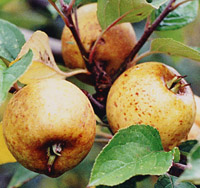
HARVEY Known since 1600, when it was called the Round Russet
Harvey. It has also been called the Brandy Apple, as it made very strong
cider due to the high specific gravity of the juice. The fruit is small
and uniformly golden, with thin and patchy russet. It has an intense flavour
when ripe in late October, developing further when stored until March.
It was a traditional Victorian dessert apple as well as a cider apple,
being very rich and sweet. Spur bearing and excellent for espaliers. Pollination
Group 4 |
|||
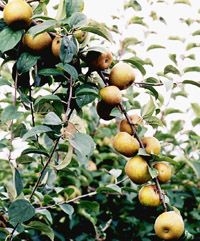 |
GOLDEN KNOB A Somerset dessert apple known at the end of the 18th century and in the London Horticultural Society catalogue of 1826. Forsyth first described it ‘The Golden Knob (from Enmore Castle), is a handsome, though rather small, Apple, of a fine gold colour, sometimes inclining to a russet. This Apple has a pleasant flavour’. The rounded, russeted (sometimes heavily russeted) apples are green-yellow in the shade, but with an orange tint in the sun. The flesh is yellow, tinted green; crisp, juicy and with a good flavour. Bunyard, in 1920, said it was popular in markets in the early nineteenth century, and still often grown in Kentish orchards. He reports a ‘distinctive flavour’. It has also been used as a cider ‘sweet’. There is another Golden Knob (medium sized and like a russeted Cox’s Orange Pippin), recorded by Taylor in 1946 and raised by Charles Ross at Newbury at the start of the 20th century. It might still exist somewhere, but the one offered here is the small, original one. Season December-March. Pollination Group 4 | |||
GOLDEN
NOBLE Found in an old orchard in 1820, Downham, Norfolk, by Patrick
Flanagan, head gardener to Sir Thomas Hare (Hogg says Harr) at Stowe Hall,
Norfolk. A middle-season culinary and dessert apple, with a deep golden
skin and creamy flesh. It needs little sugar when cooked, is delicious
in pies and perfect with blackberries. More interesting than the ubiquitous
Bramley; by the end of the year it is sweet and pleasant to eat raw. It
was widely grown in Victorian and Edwardian gardens, as it makes a decorative
tree with good blossom. Also popular in Germany. Good crops, high in vitamin
C. Partially tip bearing. Pollination Group 5 |
||||
 |
GOLDEN
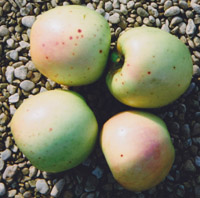
PEARMAIN An old apple first mentioned in 1727 in “A Catalogue
of Great Variety of the best and choicest FRUIT-TREES That best Thrive
in our Climate of ENGLAND. ……Collected by many Years Experience,
Increased, and to be Sold By ROBERT FURBER, At his NURSERY over-against
the Park-Gate, at KENSINGTON, near LONDON”. Accounts of this apple
seem to conflict heavily with each other and it is difficult to have confidence
that the few still known are true to name. The one we have retrieved from
America has confused us a little by having small flattened apples one
year and large oval apples the next. A good late season dessert apple,
with all the right attributes and a prolific bearer. Crisp, sweet, rich
and juicy. Golden skin, with a fine red blush in the sun. Ripe in October/November
and lasting well. Pollination Group 4 |
|||
|
||||