




| |
|||||
|
|
|
|
|
|
|
|
|
 |
 |
 |
|
||||||||
 |
||||||||||||
 |
|
|||||||||||
|
||||||||||||
 |
|
|||||||||||
|
||||||||||||
 |
|
|||||||||||
|
||||||||||||
 |
|
|||||||||||
|
||||||||||||
|
|
 |
 |
|
|||
 |
||||||
|
|
 |
ACKLAM RUSSET From Acklam, near Malton, Yorkshire. The first known date has been assumed to be 1768. Widely known throughout the country by the end of the 18th century, in 1810 William Forsyth, Gardener to George III, described it as -“Acklam’s Russet. This is a small Yorkshire apple, of a russet colour toward the sun, and yellow on the other side; it is ripe in January, and keeps till March.” It was grown in the London Horticultural Society’s garden at Chiswick, appearing in their 1826 to 1842 catalogues. Dr. Robert Hogg, one of the most significant pomologists of the 19th century, describes it as small, yellow green with thin grey russet, round, flattened with white crisp flesh, juicy and richly flavoured, ripe in November and ‘will keep under favourable circumstance to March’. It ‘succeeds best in a dry soil, and is well adapted for espalier training’. Hogg and Forsyth described it as small, though others say it is medium sized. Rogers (1837) said it was a tree of diminutive growth. It entered the National Fruit Trials in 1961, but DNA profiles of this and Reinette de Macon have been found to be the same, and their appearance is certainly very similar. It is also an area of uncertainty that Acklam Russet has been considered small, though the apple now known is medium sized. Acklam Russet has been widely grown from this stock in the National Collection and both these apples are still listed as distinct by the National Collection. We merely point out that having Acklam Russet from us might mean you have Reinette de Macon. T* Pollination Group 3 |
||
 |
ADAMS’ PEARMAIN A late season dessert apple originally either from Norfolk or Herefordshire (where it was known as the Hanging Pearmain). The London Horticultural Society received scions for grafting from a Mr Adams, and it was first recorded in the first collection catalogue of the LHS in 1826. It has been quite popular since. The apples have a rich, aromatic, slightly nutty taste and a crisp texture when fresh. The fruits are very conical, medium-sized and deep yellow, with red streaks often covering most of the apple, and with variable amounts of russeting. They store well, and can be kept until March, though they tend to shrink. The trees are vigorous, have attractive blossom, and trees have upright growth when young. Though part tip bearing, they spur freely and have been recommended for espaliers. Pollination Group 3 |
|||
 |
ALABASTER
A lovely and attractive white apple that appears to have first been known
in Germany and is probably very old. The only known historical reference
in England was in the report of the Royal Horticultural Society’s
Apple and Pear Conference, held at Crystal Palace in 1934, when it was
sent from Oxfordshire. It was described as a large, red streaked, middle
season, dual purpose apple, with a flat shape, lasting to November. We
discovered an apple of this name in the Nick Botner collection in Oregon
and he sent us scions to graft new trees here, early in the new millennium.
Though the fruit here is more medium sized than large, and the red streaks
are few, the rest of the characteristics are in accord. The skin is mostly
very pale, punctuated with prominent lenticels, and the flesh is also
very pale. Alabaster is ripe in late September, juicy, sweet and very
richly flavoured. It retains these qualities into mid-November, though
the apples are, by then, shrinking slightly. There is an earlier history
in Europe and America. Charles Gibb, of Abbotsford, Quebec, undertook
the task of cataloguing and renaming hundreds of fruits which had been
sent to the U.S. Dept. of Agriculture from Russia in 1870. Most of the
apples were Russian, though some were originally from elsewhere in Europe,
judging by the names given by the Russians. The task was to give the fruits
names more palatable to the American public. Gibb’s publication
– “The Nomenclature of our Russian Fruits” – from
the American Pomological Society’s report of 1887 – revealed
that Russia had this apple under the name of Weisser Alabaster, presumably
having received it from Germany some years before 1870. Gibb renamed it
Alabaster. Pollination Group 4 |
|||
 |
ALAN’S APPLE A very good old apple discovered by Hilary Wilson of Appleby-in-Westmorland, who sent us scions early in the new millenium. She found this old apple tree in the garden of the late Mr Alan Leffley, then in his 90s, of the old village of Hayton in Allerdale, Cumberland. We jointly named it after him, since it is not a variety now known. It is a dessert apple, medium sized but quite often large, ribbed and with a pretty colouring of strawberry red and carmine streaks and blushes, over very pale yellow, almost white. The flesh is very sweet, crisp, juicy and well flavoured. It is ripe in late September or early October and will last until December, in the South, though softening with storage and the flavour fades towards the end of the year. It is inclined to fruit when young and is spur bearing. A valuable apple for both North and South. Showy pink blossom. Pollination Group 5 | |||
 |
ALDBROUGH DOG’S SNOUT When Jess Young was newly arrived in the village of Aldbrough St. John, a very old settlement near Richmond, North Yorkshire, he took a walk to acquaint himself with the place. He was intrigued by a scruffy old apple tree he discovered just outside of the village, on a lane verge, now public land, though technically still owned by the adjacent farm. The tree was in fruit and Jess sought our views on such a strange apple. A hedge separates the verge from the farm now, the hedge having been moved back 50-60 years ago, according to the farmer John Gill, because the old hedge was on a 90 degree bend, obscuring visibility and deemed dangerous. Mr Gill also reported to Jess Young’s enquiries that he thought the tree might have been donated by a now deceased individual who found it as a young tree about 50-60 years ago. Mr Gill’s father referred to the apple as ‘dog’s snouts’. The tree does appear to be older than that account, but apple trees can be very deceptive and this particular tree has had a cruel life. It has multiple trunks as if the original trunk rotted away and the lower living bark sent up new trunks, but it has received regular trimming from tractor mowers in the past and has re-grown very bushy. It is such an ‘individual’ apple that it is either a very old variety or a chance seedling that has revealed some ancient characteristic. It is certainly worthy of preservation, the apples being of good quality and the tree being an abundant bearer. Jess Young sent us apples and scions and new trees were grafted in 2018. The apples are large, bright green with an amber blush, very long and ribbed, with a waist towards the eye, giving a snouty appearance. The core is large, hollow and with few if any pips. The apple is really rather light and the texture yielding, sweet enough to eat, though sometimes a little sharp, but better cooked, preferably stewed or poached, when it softens fairly quickly and keeps its shape. The acidity is less and it develops a rich lemony flavour. Ripe from late September, it will last to early December but with some shrinkage. We are grateful to Jess Young and John Gill for all their help in the story and for preserving this interesting apple. | |||
 |
ALDWICK
BEAUTY
From the seaside parish of Aldwick, just west of Bognor Regis, West Sussex,
it originated with Mrs D.M. Alford. An early season, attractive dessert
apple, ripe in August and September, medium sized, round and flattened
in shape, with bold red stripes and flushed with glowing crimson. It was
sent to the National Collection in the late 20th century. A much under-appreciated
apple with a rich flavour for an early apple. Pollination Group 4 |
|||
 |
ALEXANDER
Originally called Aport and probably from the Ukraine. It was renamed
Alexander when introduced to England in 1805 by the nurseryman James Lee.
It was sent to Massachusetts, USA, before 1817. Alexander has been widely
grown all over Northern Europe. It is a large, or very large, apple and
Hogg recounts that one exhibited by James Lee was 5½” in
diameter and weighed 19ozs. A showy apple of lemon yellow, with red streaks
on the shaded side, but orange, flushed bright red on the side next to
the sun. It was a popular Victorian exhibition variety. A useful mid-season
cooking apple, which cooks to a sweetish, scented purée, and is
also a pleasant dessert apple. Although it will last to the end of November,
the flavour and texture suffer, so it is best used in September/October.
The cream flesh is crisp, juicy and aromatic. A vigorous tree, with good
crops, which was often used for espaliers as the fruit was so attractive.
Pollination Group 4 |
|||
 |
ALFRISTON
A large cooking apple with cream, crisp flesh, sweet and sharp early in
the season and mellowing with age. The skin is greenish-yellow in the
shade, tinted orange to brown next to the sun, and sometimes covered with
veins of russet. Very popular in the nineteenth century, when it was known
as one of the best cooking apples. It was bred by Mr Shepherd of Uckfield,
East Sussex, in the late eighteenth century, and was originally known
as Shepherd’s Pippin, but was renamed Alfriston in the late nineteenth
century. It stores well, and was once popular with sailors on long voyages.
When first gathered and cooked, it keeps its shape fully, to the point
of being quite firm, and has a good tang and a rich but subtle flavour.
Later in November, though it will keep some shape, it would mash to a
purée. It welcomes a little sugar added and being a little more
tart than some other cooking apples, it makes a lively sauce. Vigorous
trees, with good crops. The apples are large but regularly shaped and
will last into December. Pretty pale blossom. Pollination Group 3 |
|||
 |
ALLEN'S
EVERLASTING
An Irish apple, probably introduced by Thomas Rivers in the mid nineteenth
century. Once known as one of the best late dessert apples, it is rough
skinned, crisp, juicy and intensely flavoured. Very suited to cordon or
espalier training, as it readily forms fruiting spurs and the modest growth
allows easy training. As a standard the habit is rather compact and slow
to reach any great height. It is said to store as late as June, but in
our current climate this might be stretching a point. Hogg says it was
also a good culinary apple, though the size is modest. Attractive dark
flower buds. Pollination Group 4 |
|||
 |
ALLGROVE’S
PURPLE CRAB The old Veitch’s Nursery at Middle Green, Langley,
Buckinghamshire, was taken over by the Allgrove family in the mid-20th
century and closed at the end of the century, with the passing of Jim
Allgrove. When we visited him in 1995, he showed us a purple skinned,
red fleshed apple, which he grew, but without a name. When he died, the
nursery went wild and names of closely planted trees were lost, but a
friend of the family who knew the nursery well, Nick Houston, was able
to find a few varieties and he brought us scions to graft. This apple
was one. Though we call it a Crab, since it resembles in some ways the
Siberian crabs, like Malus Niedzwetzkyana, it obviously has some Malus
Domestica in its parentage as it is not a harsh, hard Russian Crab. Ripe
in October, the flesh is red throughout, spongy and glistening when cut,
from the juiciness. The flavour is sweet, with a little acidity, rather
than sharpness. It is a fair eating apple, but not strong in flavour and
would serve better in a colourful salad or juiced. The slightly conical,
lightly ribbed apples are medium sized to large, with deep carmine glossy
skin, overlaid with thin, reddish and mottled russet. The wood has dark
coloured bark, with a little red underneath, but the wood is not so red
stained as other ‘crabs’ like Malus Niedzwetzkyana. An interesting,
if not classic, eating apple but one which has not been fully tested by
us yet and which might have merits when cooked. Our new trees have been
slow to fruit, so we cannot yet say. Very attractive copper to red foliage. |
|||
 |
ALLINGTON PIPPIN It was raised in South Lincolnshire before 1884 by Thomas Laxton, as Brown’s South Lincoln Beauty, and introduced by Bunyard’s Nurseries in 1896 under the current name. This dessert and culinary apple is a cross between Cox’s Orange Pippin and King of the Pippins, and has the same rich, aromatic flavour and crunchy texture. The attractively striped fruit is of medium size and will also cook well, keeping its shape. Fruit is ready at the end of October and can be stored for a month or two. The crop is heavy, but can be biennial, unless thinned during a year of abundance. Pollination Group 4 |
|||
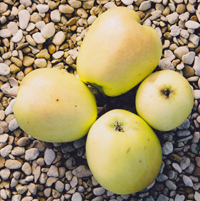 |
ALVEDISTON
A new name for a very old tree, owned by Victoria Spendlove at Alvediston,
near Salisbury, Wiltshire. The appearance of the tree would suggest it
was planted in the early or middle 19th century. It is now 76 inches around
and was mature in the 1950s when the previous owner was a child there.
It was the only tree in the garden. The property was built in the mid
18th century, attached to a large farm, and the tree is a likely sole
survivor of the farm orchard. The apples are long and oval to conical,
with apple green skin turning yellow and often developing a rosy cheek
when ripe from mid-October. By early November the apples are pleasant
to eat with a fruity, sweet flavour, but its primary use is for cooking,
when it softens quickly, but keeps its shape, though it would mash to
a purée. The flavour is rich, fruity, lemony and only mildly acid;
sweet enough without adding sugar. The apples can be stored into January.
It is a mystery why there were so few Wiltshire apples recorded and so
few still known with their names still connected. We are grateful to Victoria
for her help with photos, apple parcels and scionwood in 2013 and Wiltshire
now has another excellent apple to its name. Pollination Group 5 |
|||
AMERICAN
GOLDEN RUSSET
Of unknown origin but with a long history in America and first mentioned
by Coxe in 1817 as Bullock’s Pippin. Downing renamed it in 1845.
It is said to have originated in Burlington County, New Jersey. It was
in Britain, in the first catalogue of the London Horticultural Society
in 1826. Hogg described it as a late dessert apple, lasting to January
and the size of Golden Harvey (small). The shape is roundish ovate, but
it can be tall. Regular in outline. Yellow skin with patches of pale brown
or ashen grey russet. The skin is tough and the flesh yellowish, tender
and fine, juicy, rich and aromatic. Scott says it resembles in texture
a fine buttery pear, valued for high flavour and great produce. We find
the apples ripe in early November, crisp but crunchy and breaking, juicy
and very richly flavoured. They can be stored to January and have also
once been used as a cider ‘sweet’. It is still commonly grown
in America. Pollination Group 4 |
||||
 |
AMERICAN
SUMMER PEARMAIN
This apple predated 1817, when it was described by Coxe in America. By
1826 it had entered the collection of the London Horticultural Society,
at Chiswick. Hogg, in 1884, described it as medium sized, oblong, regular
and handsome. The skin is yellow with patches and streaks of pale red,
with brighter red near the sun. The flesh is yellow, tender, rich and
pleasantly flavoured. He adds it is an excellent early apple for dessert
or culinary purposes, ripe at the end of August and keeping to the end
of September. By then we find that while it is still crisp, yielding,
juicy and sweet, the flavour is fading. A good bearer and good on light
soils. Scott says that it is reckoned to be a seedling from the ‘English’
Summer Pearmain. He calls it ‘rich and highly esteemed in America’.
The American pomologist Downing also suggests it arose from the ‘English’
Summer Pearmain. Pollination Group 3 |
|||
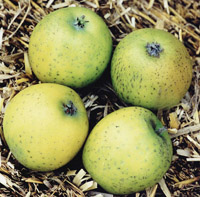 |
ANANAS
REINETTE
A first class apple, first listed in Europe, by Diel in Germany in 1821.
Scott claimed to have brought ‘Reinette D’Ananas’ to
England, from Metz, in 1872, but it was noted in the ‘Proceedings
of the Royal Horticultural Society Vol. 2-5, 1862-5’ as being in
the RHS collection, as Reinette Ananas. It was there described as medium
sized, ovate, flat at the top, citron yellow, for table use, of top quality
and in use from November to February. The name was often anglicized to
Pineapple Reinette. It was thought to have originated in Holland, though
it was mentioned by many European writers in the 19th century and widely
grown. The fruit is small to medium sized. Scott says it is first quality,
conical, rounded at the base and with skin of grass green turning pale
yellow, with a slight orange tinge near the sun, all lightly dotted. The
flesh is firm, rich, sugary and acidulated. It bears when young and is
a good juicing apple. It has a distinct pineapple flavour by November.
Though a dessert apple, it is also rated a good culinary apple, keeping
its shape when cooked. Good crops, ripe in October and keeping to January,
though the apples tend to shrink and we find the flavour fades in December.
Upright growth. It is still widely grown in Europe. Pollination Group
4 |
|||
 |
ANNIE
ELIZABETH Also
called Carter’s Seedling or The George. A late culinary apple, introduced
by an amateur grower called Samuel Greatorex, of Knighton, Leicestershire,
in 1857 and named after his daughter who died at 13 months. The large,
sweetish fruits keep their shape when cooked and need very little sugar.
They will keep until April. The trees were once popular in ornamental
orchards because of their striking deep pink and maroon blossom. George
Bunyard and Owen Thomas (1904 The Fruit Garden) reported that the tree
would keep hold of its fruit in windy weather. Free spurring and trees
fruit when quite young. Pollination Group 5 |
|||


